On this page
Quick summary
Singapore music conservatories suffer swollen upright piano hammer felts and cracked soundboards when tropical relative humidity swings sharply between wet rainy afternoons and over-cooled lesson slots. Pairing steady 45–55% humidity control, low-noise fan curves, and scheduled commercial servicing protects acoustic tuning stability.
Wall-mounted general servicing $25–$50/unit · chemical wash $60–$80/unit · View servicing rates
Why Rapid Humidity Swings and Direct Drafts Harm Piano Actions
Singapore outdoor humidity often tops 80% during rain, yet blasting booths to 19 degrees between lessons dries wood too fast. Soundboards swell in damp air and shrink under cold blasts, loosening tuning pins and stiffening hammer felts.
Hold booths near 45% to 55% relative humidity with gentle 23 to 24 degree setpoints. Never aim cold vents straight across open piano lids. Sudden air swings also push steel strings out of tune faster across wet months.
Small hygrometers clipped near piano frames log overnight humidity spikes. Staff can spot damp climbs early before upright hammers stick.
Compare Piano Booth Symptoms, Causes, and Control Fixes
Monitor digital hygrometers inside each practice booth before lessons start so subtle aircon drift gets fixed before hammers stick:
Scroll to see more columns
| Studio booth symptom | Underlying moisture or fan issue | Immediate booth adjustment | Commercial service step |
|---|---|---|---|
| Sluggish hammer return | Booth RH climbing above 65% | Run gentle dry/24-degree hold | Verify sensor calibration & coil wash |
| Loud airflow during exams | Dust-unbalanced squirrel-cage wheel | Lock low fan away from mics | Strip and balance blower wheel |
| Musty felt odour after weekends | Standing condensate in slimy tray | Leave cabinet vents unobstructed | Chemical tray flush + drain clear |
| Uneven cooling across rooms | Blocked condenser or VRV valve lag | Log room-by-room hygrometer gap | Book S$30 split or S$80 VRV check |
Keep Practice Booths Whisper-Quiet Without Trapping Moisture
Dust on fan blades causes rhythmic whooshing noise that ruins exam focus and mics. Oversized splits on high speed cool rooms too fast before pulling damp air out. A noisy squirrel-cage fan easily distracts students preparing for classical grade tests.
Set low or medium fan speeds with clean coils so air loses moisture quietly. Seal acoustic door sweeps tightly instead of shutting units off over humid weekends. Check floor-level condensate drains weekly before busy Saturday teaching blocks begin. Keep grille slots dust-free before every exam term.
Schedule Multi-Booth Servicing and Inspection Rates Smoothly
Coordinate after-hours cleaning across studio floors so damp trays never overflow onto timber parquet or acoustic carpets:
- On-site booth checks cost S$30 for split premises or S$80 for commercial VRV plants. Both check fees waive whenever approved repairs proceed (30-day warranty).
- Routine teaching-room washes charge S$50 for one room or S$30 per booth on two rooms. Three-plus booths run S$25 per booth (14-day cover).
- Bi-annual sanitising clears mould spores via studio chemical washes priced at S$80 per booth, S$70 apiece on twin booths, or S$60 per booth for three or more (60-day cover).
- Noisy unbalanced fans and tray slime need deep studio teardowns at S$150 single, S$125 per booth on twin rooms, or S$115 per booth across three-plus rooms (90-day cover).
Diagnostic Cases for This Fault
Singapore jobs showing what we checked on-site before quoting parts or gas.
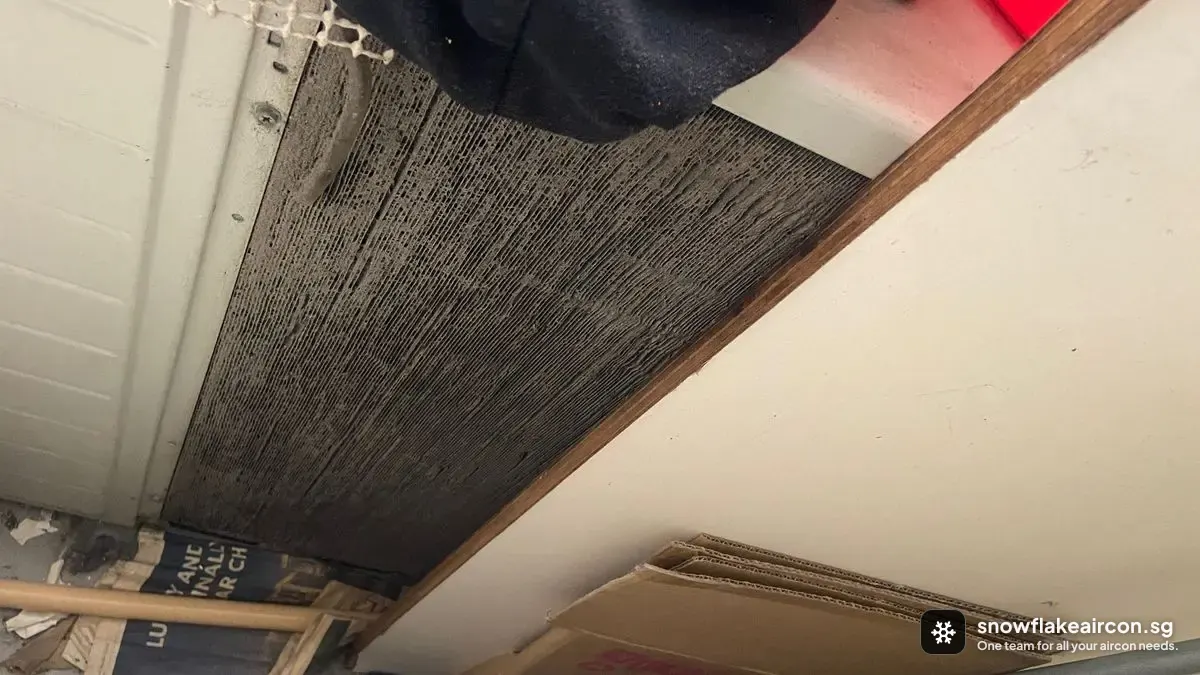
Midea · Cassette
Weak airflow over a kitchen line: grease-bound coil needs overhaul
Hardened cooking grease bound through the full fin depth and packed across the blower
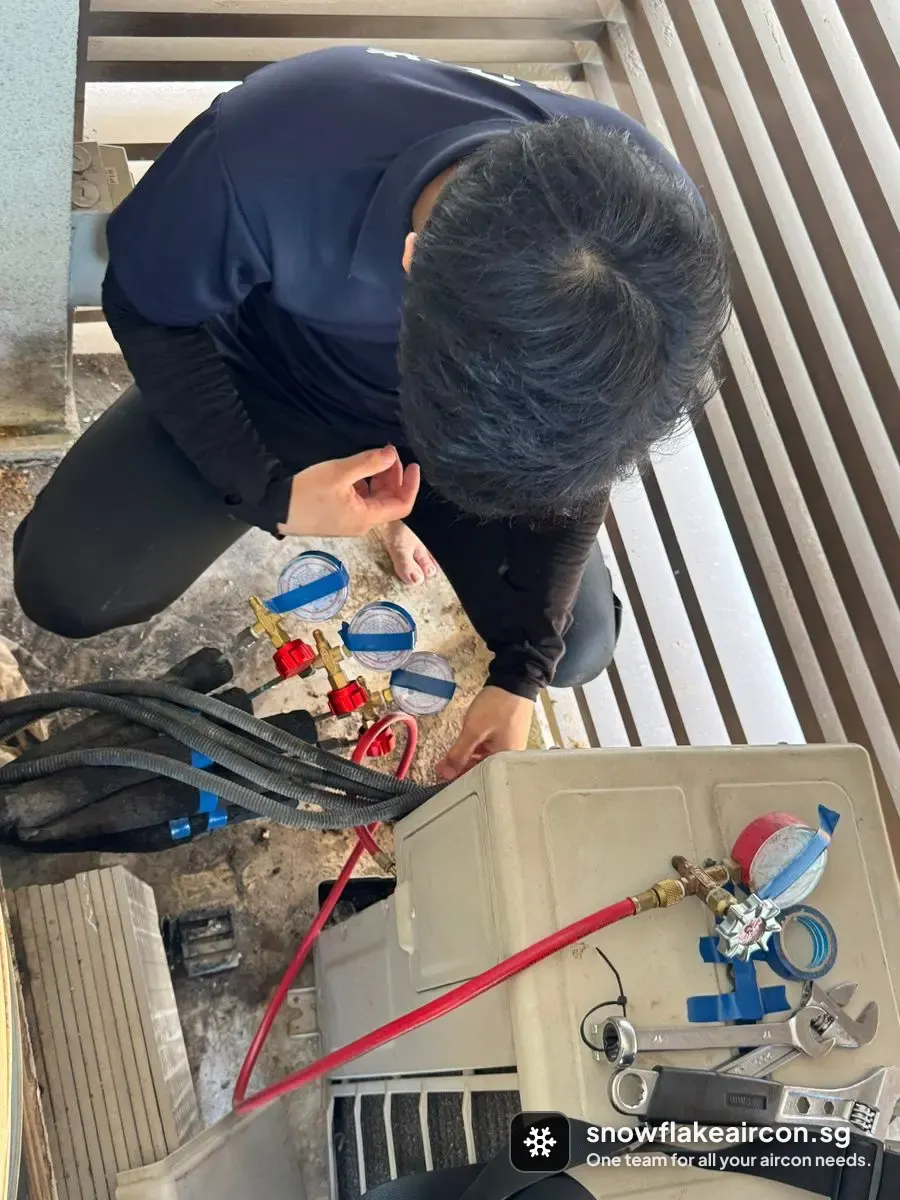
Mitsubishi Electric · Wall-mounted
Warm air with normal gas pressure: fouled coil, not low gas
Grease-choked indoor evaporator coil and dust-packed blower wheel causing poor temperature drop while refrigerant pressure stayed full
Common Questions
What relative humidity range protects upright and grand pianos in Singapore studios?
Should a music conservatory switch booth aircon completely off overnight and on Sundays?
Why do piano practice booths sound louder months after installation?
How does Snowflake inspect multi-room conservatory splits versus larger VRV plants?
Sources
Sources checked 27 Nov 2026