On this page
Quick summary
A quiet outdoor condenser fan blowing ambient air indoors happens when the compressor stops pumping while fan blades keep turning. Separating an open compressor overload, low refrigerant pressure lockout, or failed inverter PCB driver during a S$30 diagnostic check prevents pointless R32 or R410A top-ups.
On-site fault check: $30 ($80 VRV), waived if you proceed with repair · See diagnosis & repair
Why a Spinning Outdoor Fan Still Delivers Warm Indoor Air
Spotting rotating fan blades out on an HDB aircon ledge creates a misleading impression. Split condensers power the cooling fan motor separately from the heavy-draw compressor pump. Simply seeing spinning outdoor blades never confirms active refrigerant pumping.
Whenever thermal cut-outs or low suction pressure pause the compressor, fan blades keep spinning smoothly. Indoor wall coils deliver ambient warm air until gauge and ohm checks confirm which outdoor stage stopped. Most Singapore owners assume missing gas causes every warm-air breakdown.
Compare Overload, Low Gas Lockout, and Inverter Driver Clues
Technician gauges and clamp meters distinguish thermal overloads, refrigerant shortages, and inverter driver failures cleanly:
Scroll to see more columns
| Suspected outdoor fault | Audible and pipe cue | Diagnostic meter proof | Targeted corrective action |
|---|---|---|---|
| Open compressor overload | Quiet fan after brief thermal click | Open overload continuity or hot casing | Clear blocked fins; swap failed protector |
| Low gas pressure lockout | Gentle fan spin; frosted thin line | Low standing pressure on manifold | Nitrogen leak test, flare seal, refill |
| Failed inverter PCB driver | Steady fan hum; no compressor ramp | Healthy gas psi; missing phase output | Swap inverter board or review replacement |
| Seized compressor motor | Instant safety trip; ambient pipes | Locked-rotor surge or grounded coil | Plan outdoor condenser unit replacement |
Avoid Blind Gas Top-Ups and Unsafe HDB Ledge Checks
Ordering a blind R32 or R410A top-up leaves leaking flare joints unsealed. Extra gas also solves nothing when an inverter PCB fault or open overload protector stops startup. Dry nitrogen leak testing confirms leaks before technicians charge exact refrigerant weight. Overfilling an intact sealed loop also drives dangerous discharge spikes.
Remain indoors on room flooring and verify cool-mode settings plus clean intake mesh screens only. HDB care guides, BCA structural rules, and EMA electrical guidance keep untrained homeowners away from exterior ledges and live 230-volt condenser covers.
Verify Pressure, Winding Ohms, and Driver Output Before Repair
Systematic bench checks pin down the single failed circuit before committing repair spend:
- Order a S$30 diagnostic visit first (S$80 on VRV gear). Confirmed repairs credit that check charge under a 30-day warranty.
- Measure static refrigerant pressure, compressor terminal resistance, and inverter module voltage during one check before approving replacement parts or gas.
- Keep repaired condensers shedding heat reliably through routine servicing. General maintenance bills S$50 for a single split, S$30 per split when treating two rooms, or S$25 per room on three-plus systems (14-day warranty).
- Clear clogged outdoor dust or thick biofilm off heat exchangers cleanly. Chemical cleaning bills S$80 for a single split, S$70 each across two splits, or S$60 per split for three or more units (60-day warranty). Deep coil strip-downs bill S$150 for a single split, S$125 each across two splits, or S$115 per split for three or more units (90-day warranty).
Diagnostic Cases for This Fault
Singapore jobs showing what we checked on-site before quoting parts or gas.
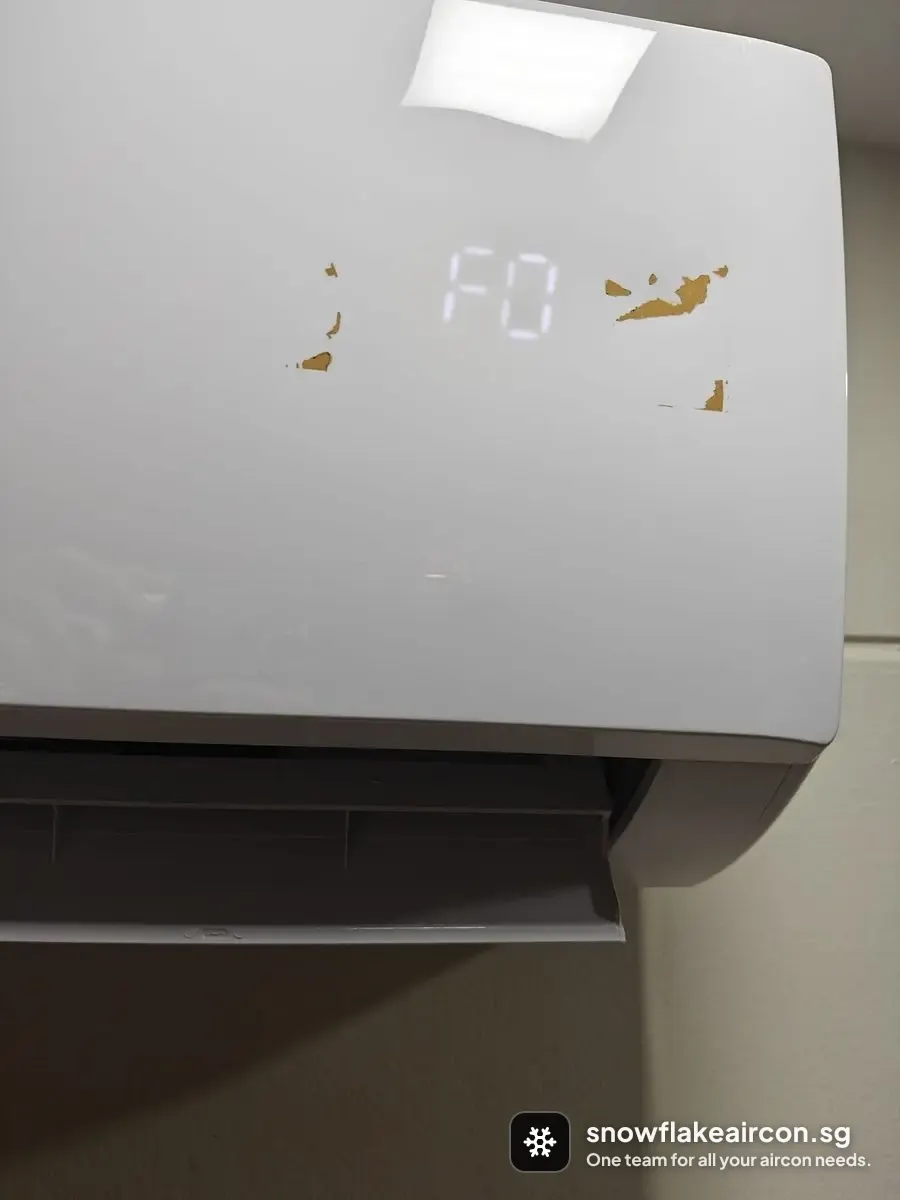
Gree · Wall-mounted
Gree F0 on a rusted condenser: refrigerant shortage
R32 refrigerant shortage triggering Gree F0 protection from corroded evaporator return bends
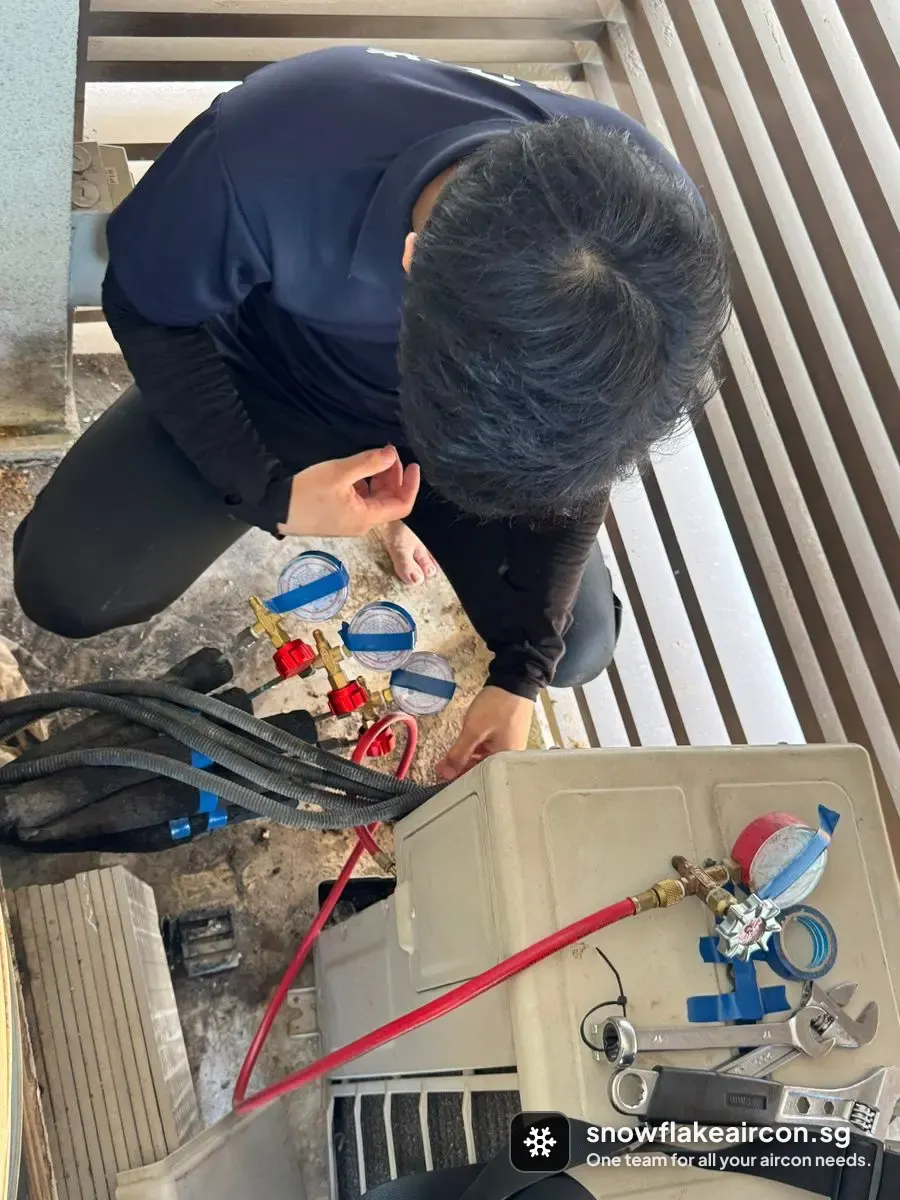
Mitsubishi Electric · Wall-mounted
Warm air with normal gas pressure: fouled coil, not low gas
Grease-choked indoor evaporator coil and dust-packed blower wheel causing poor temperature drop while refrigerant pressure stayed full
Common Questions
Why does my outdoor condenser fan spin quietly while my room stays warm?
How can a technician tell low gas lockout apart from a dead inverter driver?
Why should homeowners reject quick gas top-ups when the outdoor unit runs quietly?
Can residents check the outdoor copper pipes on an HDB aircon ledge themselves?
Sources
Sources checked 27 Nov 2026