On this page
Quick summary
Bungalows and semi-detached houses across Siglap, Frankel Estate, and Bedok South cool more reliably when ground living floors stay separate from upper sleeping suites. Proper multi-storey condenser stacking clearances, 22 SWG pipe risers, and sealed guestroom drains prevent midday thermal trips and surprise ceiling leaks.
System 2 installed from $2,600 (22 SWG copper) · $30 site survey waived on install · View packages
Separate Daytime Living Rooms from Upper Sleeping Storeys
Linking ground-floor dining rooms and third-storey attics onto one huge condenser strains compressor oil return across tall lifts. Dividing capacity across separate floor zones trims vertical pipe losses. Shorter runs also respond faster when family members enter single rooms. Dedicated ground units handle open patio doors far better.
Splitting storeys keeps bedrooms cool whenever a living-area unit requires servicing. Thick 22 SWG copper paired with half-inch closed-cell lagging keeps concealed interior shafts dry. Ensure pipe chases keep clean service doors. Proper bracket isolation also stops structural vibration reaching bedroom walls.
Compare Landed Condenser Stacking and Drain Options
Confirm bracket spacing, vertical riser paths, and drain slopes before false ceilings close up during renovation:
Scroll to see more columns
| Landed house zone | Recommended split layout | Piping and clearance spec | Drain protection measure |
|---|---|---|---|
| Ground hall and dining | Dedicated heavy single or twin | 22 SWG copper + 0.5-inch insulation | Slope direct to perimeter apron drain |
| Level 2 bedrooms | 5-tick System 3 or System 4 | Short lateral branch trunks | Clean quarterly to clear coastal dust |
| Attic and idle guestroom | Independent mini split or sealed trap | Minimum 1:50 gravity drain fall | Fit accessible tee and floor P-trap |
| Stacked side-alley brackets | Staggered frames with louver baffle | Keep 600 mm vertical air clearance | Prevent hot discharge rising upward |
Prevent Stacked Condenser Heat and Idle Guestroom Leaks
Condensers stacked vertically down narrow Bedok South or Frankel side walkways recirculate hot exhaust under eaves. Fitting side-discharge air deflectors prevents lower machines from heating upper intakes. Licensed electrical workers must also check outdoor isolator ratings. Proper spacing lets mechanics access every valve safely.
Guestrooms left switched off for months accumulate damp algae inside flat drain trays. Once dry periods harden that slime into brittle flakes, turning cooling on flushes debris straight into elbow traps. Adding flush tees avoids cutting drywall later. Run dormant guest splits monthly for twenty minutes.
Plan Your Landed Site Survey and Recurring Upkeep
Verify condenser bracket access and intermittent guestroom drains early with a structured landed maintenance schedule:
- Walk through floor-by-floor zoning via our S$30 landed survey (VRV surveys S$80). Survey charges waive against approved installs or fixes carrying 30-day coverage.
- Occupied living halls and suites stay crisp with routine upkeep. Bills run S$50 for a single wall split, S$30/unit on two splits, and S$25/unit on three or more splits (14-day coverage).
- Coastal Siglap moisture feeds tray jelly best flushed through chemical washes: single splits cost S$80, paired splits run S$70 apiece, while three or more splits run S$60 per split (60-day coverage).
- Dormant guestroom coils benefit from strip-down chemical overhauls before guests arrive. Full teardowns bill S$150 (solo), S$125 apiece (pairs), and S$115 apiece (three-plus coils), backed by 90-day coverage.
Diagnostic Cases for This Fault
Singapore jobs showing what we checked on-site before quoting parts or gas.
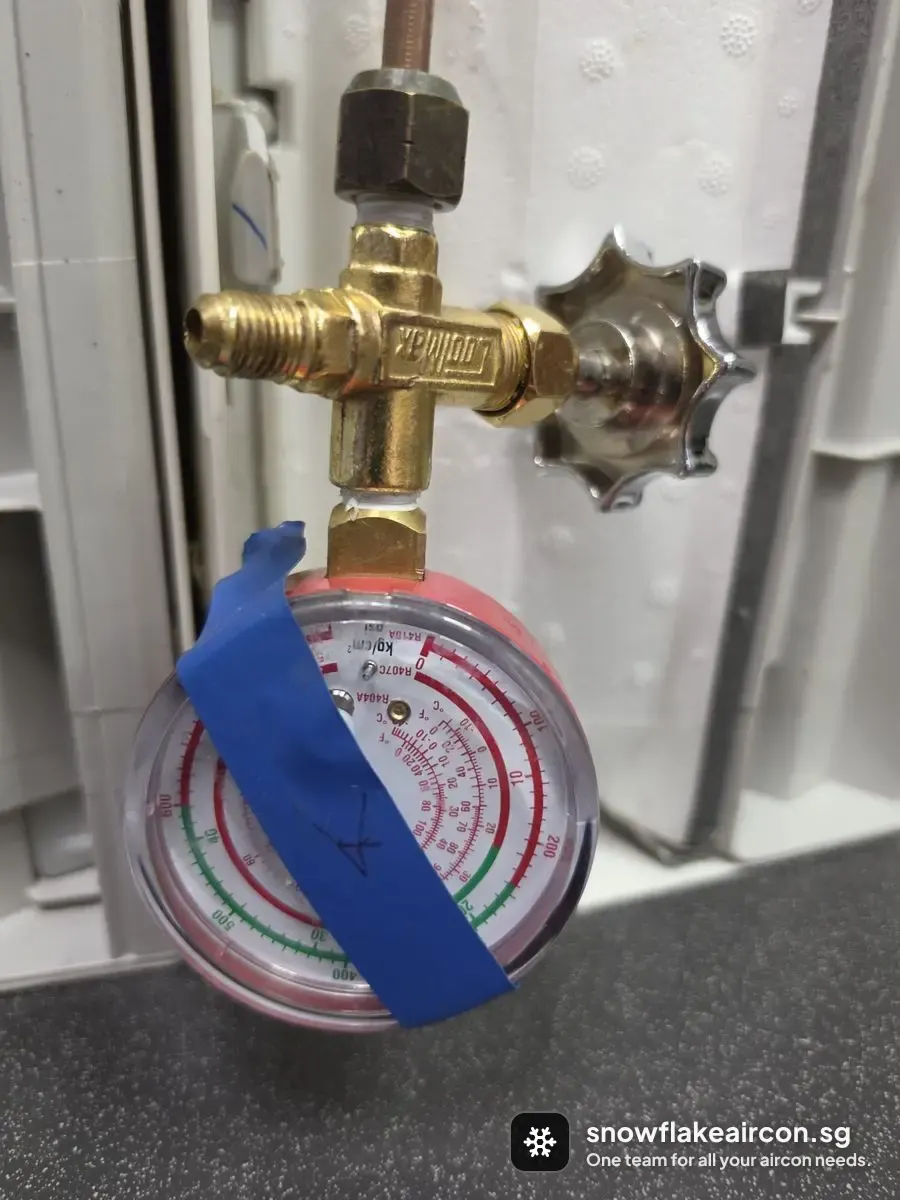
Panasonic · Wall-mounted
Warm air after gas top-up: leaking Schrader valve core
Weeping Schrader valve core behind a finger-loose outdoor brass flare cap slowly venting R32 charge over six months while the concealed copper pipe run stays intact
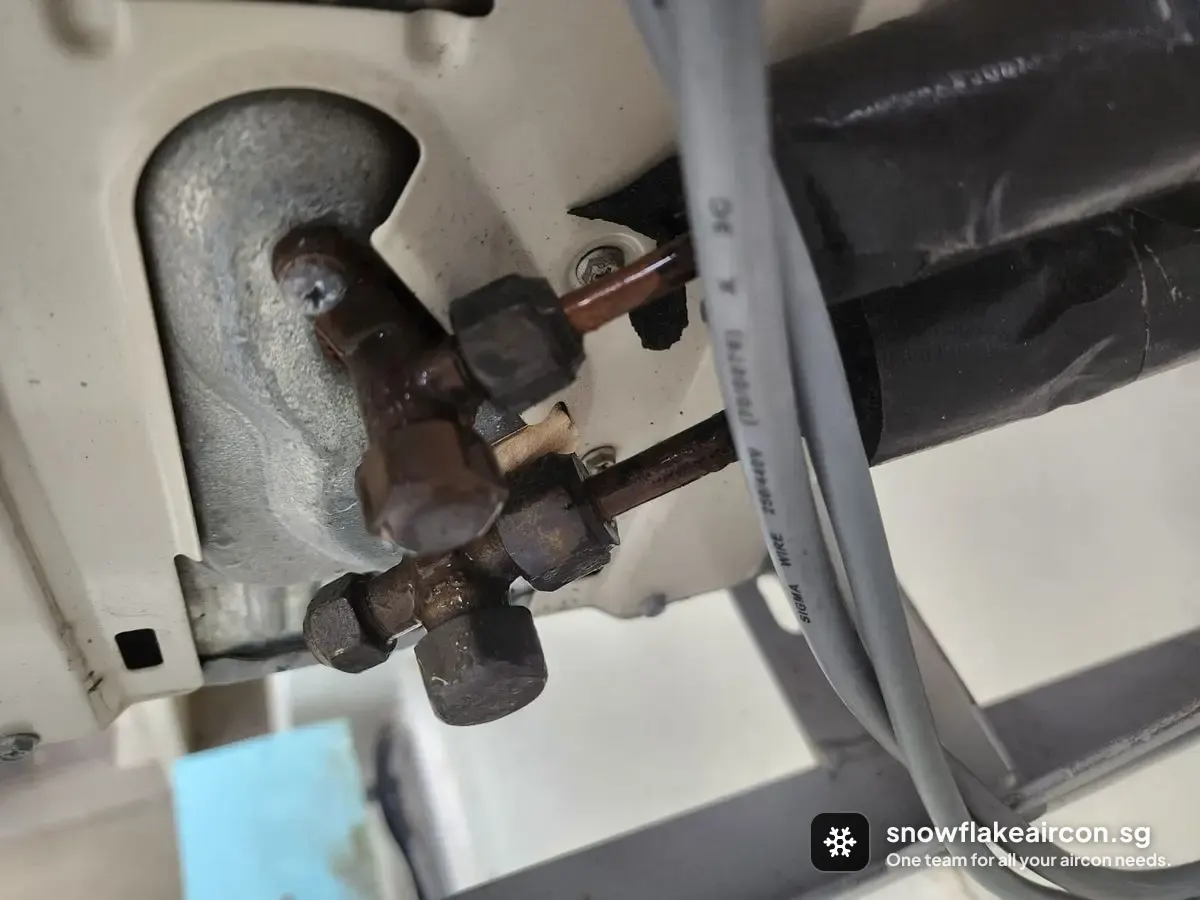
Samsung · Wall-mounted
Coastal unit losing gas again: salt ate the pipe fitting
A corroded outdoor fitting thinned past the point where it can seal