On this page
Quick summary
Checking SP app half-hourly electricity bars between midnight and 5 am reveals hidden aircon faults. Healthy bedroom inverters drop to gentle draw after cooling down. Constant 1.5 kW flatlines instead point to drifted sensors, choked coils, or low gas.
Wall-mounted general servicing $25–$50/unit · chemical wash $60–$80/unit · View servicing rates
Why Midnight SP App Charts Expose Aircon Faults Clearly
Between midnight and five in the morning, induction stoves, dryers, kettles, and irons stay idle across Singapore homes. Only refrigerators and sleeping-hour aircons drive half-hourly smart meter readings.
One healthy 9,000 BTU inverter set at 25 degrees cools briskly for thirty minutes first. It then throttles down into light maintenance draw for the rest of the night.
When every half-hour slot locks near 1.5 kW until dawn, the compressor never reaches rest speed. Something inside the cooling loop or sensor path is forcing maximum load.
One faulty bedroom running at 1.5 kW overnight wastes around 9 kWh per sleep cycle. Across thirty nights, that hidden fault quietly inflates bills by over S$80.
Compare Healthy Sleep Draw Against Flatline Power Waste
Compare overnight SP app patterns across one bedroom split using SP Group's late-2026 tariff of 31.16 cents per kWh (including GST):
Scroll to see more columns
| SP half-hourly load (00:00-05:00) | 8-hour energy draw | Estimated monthly night bill | Likely equipment cause |
|---|---|---|---|
| 0.9 kW start then 0.3 kW hold | ~2.8 to 3.4 kWh | ~S$26 to S$32 monthly | Healthy single-room inverter cycle |
| Constant 1.2 to 1.5 kW flat | ~10 to 12 kWh | ~S$93 to S$112 monthly | Choked fins, bad probe, or low gas |
| Sharp 2.0 kW spike every 2 hrs | ~4.5 to 6.0 kWh | ~S$42 to S$56 monthly | Storage water heater left powered |
| Steady 0.12 kW idle baseline | ~1.0 kWh | ~S$9 monthly | Fridge and standby chargers only |
Rule Out Water Heaters via a One-Night Isolator Test
First confirm that a storage water heater or stuck thermostat is not cycling overnight. Flip the bathroom heater switch off for two straight nights and inspect the fresh SP graph.
Next, feel supply vents from floor level and inspect washable mesh screens for grey dust. Matted evaporator coils trap cold air inside the blower so outdoor compressors run flat out.
Homes with multiple bedrooms can also alternate which unit runs overnight. Watching which room triggers the 1.5 kW block pinpoints the troubled evaporator.
Check Coil Fouling First or Book Fault Diagnosis
Resolving a 1.5 kW night flatline cuts around S$60 to S$80 monthly off electricity bills:
- Wash indoor mesh screens gently from floor level first. Weak cooling afterwards warrants general servicing: one unit runs S$50, pairs run S$30 per unit, and bookings covering three-plus heads drop to S$25 per unit under 14-day warranty.
- Greasy lint blocking deep aluminium fins calls for chemical treatment. Treating one blower costs S$80, pairs pay S$70 per unit, while multi-splits with three or more heads drop to S$60 per room with 60-day cover.
- Clean blowers still pulling steady 1.5 kW loads or lukewarm air need a S$30 diagnostic visit. That fee drops off whenever repair work proceeds.
- Technicians check coil superheat, thermistor ohms, and nitrogen test pressure before quoting gas work under 30-day warranty terms.
Diagnostic Cases for This Fault
Singapore jobs showing what we checked on-site before quoting parts or gas.
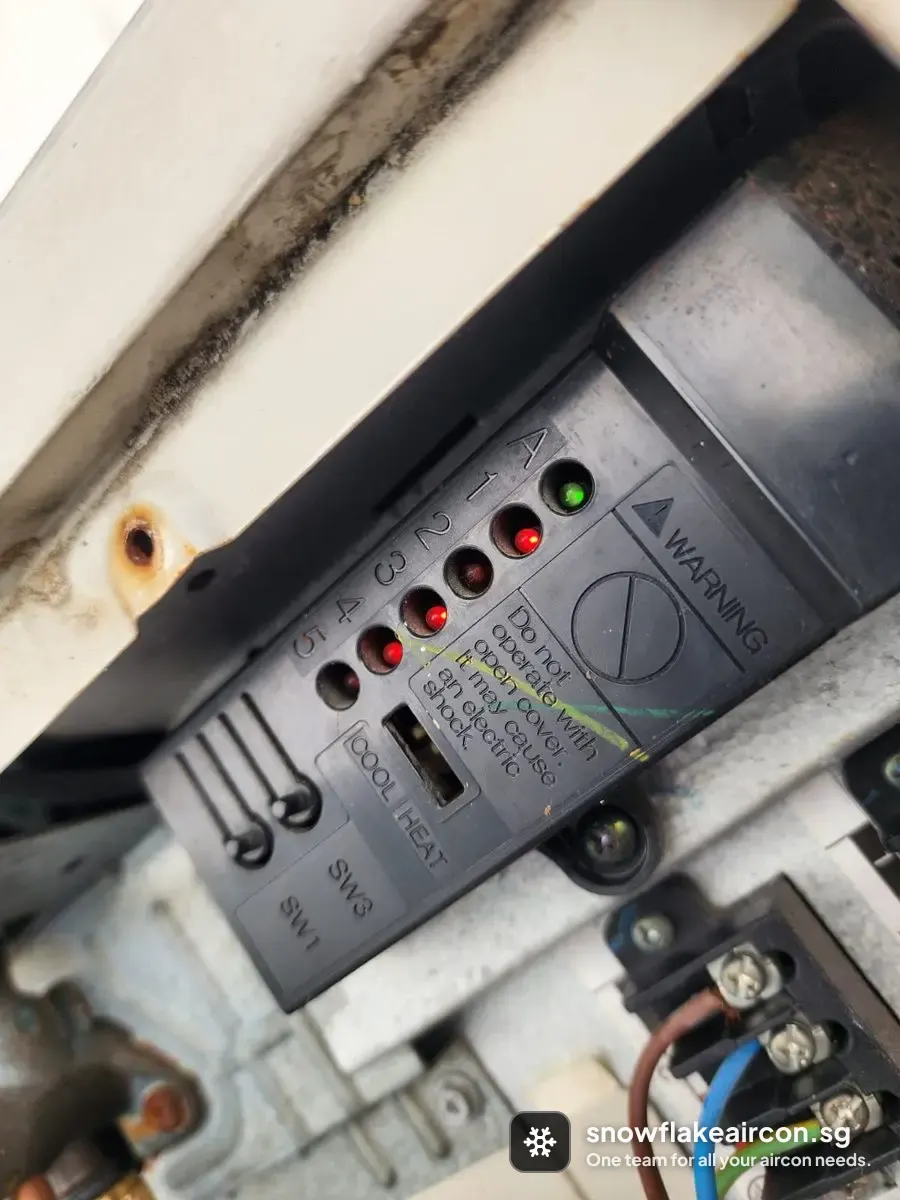
Daikin · Wall-mounted
Daikin J6 outdoor red LED: bad thermistor, not condenser
Open-circuit Daikin outdoor heat-exchanger thermistor halting multi-split cooling via outdoor safety protection while the inverter compressor stays healthy
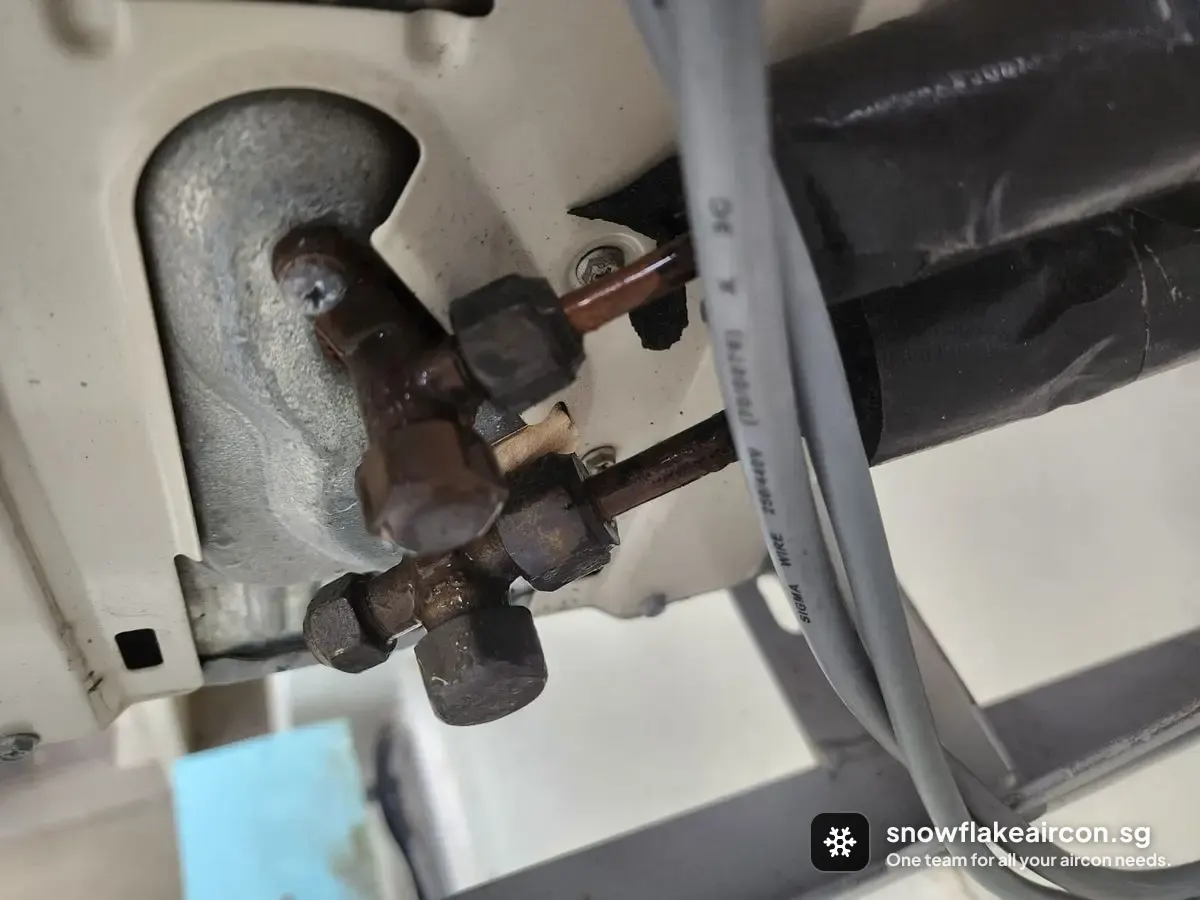
Samsung · Wall-mounted
Coastal unit losing gas again: salt ate the pipe fitting
A corroded outdoor fitting thinned past the point where it can seal
Common Questions
How fast do half-hourly aircon power spikes show up inside the SP app?
Can clogged indoor filters alone cause a 1.5 kW overnight flatline on SP charts?
How much extra does a 1.5 kW faulted aircon add to monthly Singapore bills?
Does a flat 1.5 kW SP chart always confirm a refrigerant gas leak?
Sources
Sources checked 27 Nov 2026