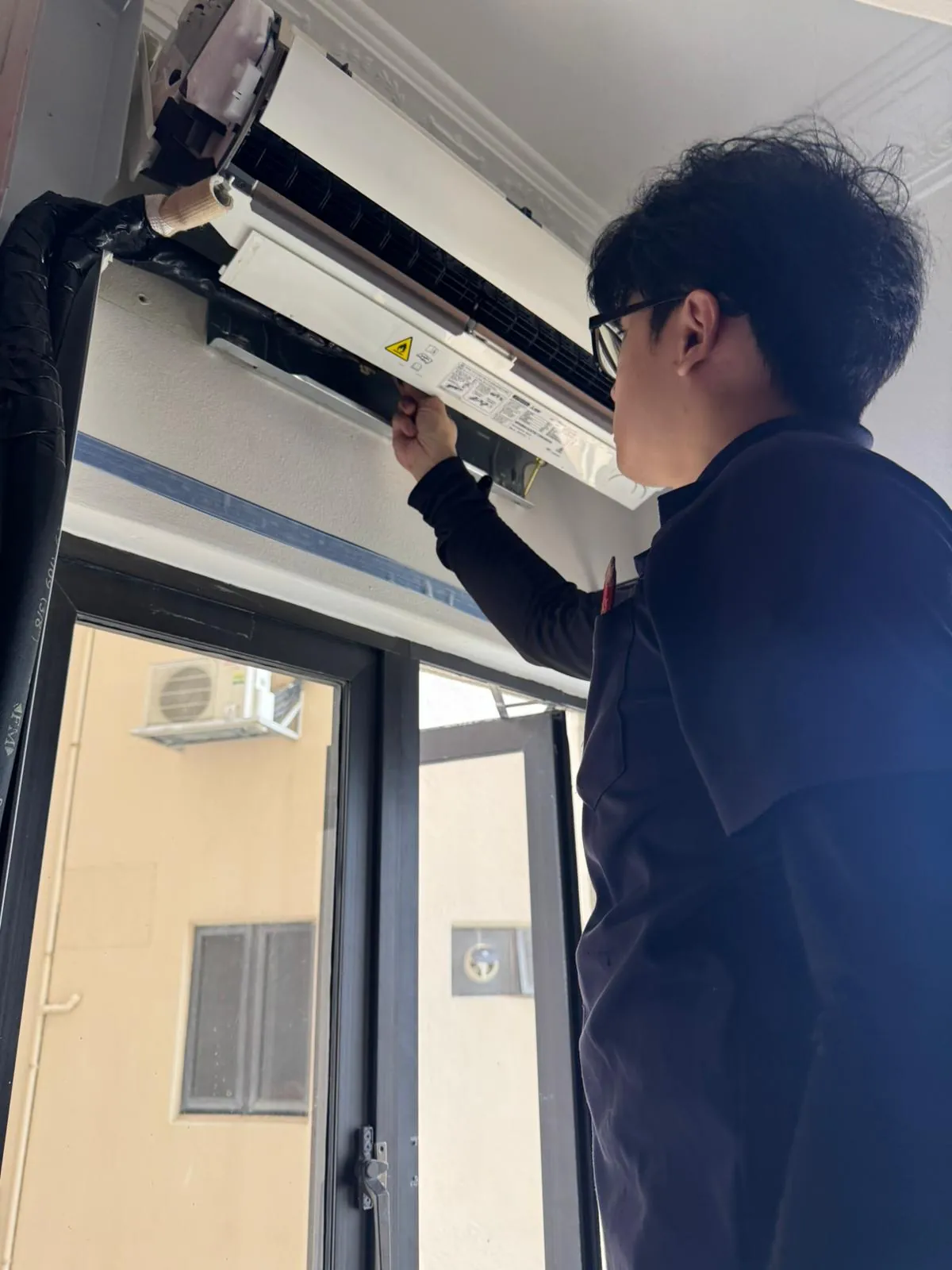
VRF / VRV aircon repair in Singapore
VRF and VRV systems coordinate multiple indoor units, one or more outdoor modules, refrigerant controls, addresses and central or wired controllers. We identify whether the fault is local, shared, mechanical, electrical or refrigerant-related before recommending work.
BCA-registered10,000+ jobs completed
Signs your VRF / VRV system needs repair
The visible symptom identifies where to start, not the replacement part.
Several zones stop or show related codes
A shared power, pressure, communication, outdoor-module or central-control fault can propagate through the network.One indoor group remains offline
The cause may sit in that indoor unit, address, controller, branch device, valve or local communication path.The fault returns under higher load
Pressure, fan, inverter, compressor, refrigerant-distribution and module-cooling protections may appear only as system demand rises.
The VRF / VRV systems we repair
These examples describe the main equipment layouts we encounter. The list is not a model restriction.
Commercial VRF and VRV heat-pump systems
Send the indoor and outdoor model labels so we can confirm the exact service and diagnostic scope.Heat-recovery systems with branch or mode-control units
Send the indoor and outdoor model labels so we can confirm the exact service and diagnostic scope.Cassette, ducted and other indoor units on wired or central controllers
Send the indoor and outdoor model labels so we can confirm the exact service and diagnostic scope.
Confirm your system
The unit showing the code, the outdoor-module number, controller, address and operating history are essential because one display can relay a fault generated elsewhere. A master outdoor, slave outdoor, branch controller, indoor unit or network fault can affect one zone, one group or the complete building system.
What can look like a component failure
We check these system-level causes before a major electrical or refrigerant repair is quoted.
Commissioning or address condition
Incorrect addressing, duplicate controllers, topology changes or an uncompleted commissioning step can imitate a hardware failure.Relayed fault from another unit
A controller or indoor display may show a generic outdoor or system alarm while the detailed root code sits on another module.Maintenance or operating condition
Restricted airflow, blocked coils, failed fans, closed valves or unstable supply can drive a healthy control system into protection.
Official VRF / VRV fault-code evidence
1480 model-scoped fault guides across 12 supported brands help identify where diagnosis should start on this equipment type.
Carrier119 guides
- 0ARepeated central-control address
- 0C50 Hz zero-crossing fault
- 01Indoor ambient temperature sensor Ta failure
- 02Indoor coil temperature sensor Tc1 failure
- 03Indoor coil temperature sensor Tc2 failure
- 04Indoor TW sensor failure
- 05Indoor EEPROM failure
- 06Communication failure between indoor and outdoor units
- 07Communication failure between indoor unit and wired controller
- 08Indoor drainage failure
- 09Repeated indoor-unit address
- 20 / 20-0Defrosting temperature sensor Tdef failure
- View all Carrier error-code guides
Daikin144 guides
- A0External protection device activated
- A0-11An indoor-unit R32 sensor detected a refrigerant leak
- A0-20A BS-unit R32 sensor detected a refrigerant leak
- A0/CHLeak-detection safety-system error
- A1Malfunction of indoor unit PCB
- A3Drain level control system abnormality
- A4Malfunction of freezing protection
- A5High pressure control in heating or freeze-up protection control in cooling
- A6Malfunction of fan motor
- A6-28VAM airflow dropped below the legal threshold for the R32 application
- A6-29VAM airflow is approaching the legal threshold for the R32 application
- A6-30VAM warning for reduced airflow in the R32 application
- View all Daikin error-code guides
Fujitsu103 guides
- 3AIndoor unit communication circuit (wired remote controller) error
- 4AIndoor unit air temp. thermistor error
- 5AIndoor unit fan motor 3 error
- 5UIndoor unit miscellaneous error
- 6AOutdoor unit display PCB error
- 9AOutdoor unit coil (expansion valve) error
- 9UOutdoor unit miscellaneous error
- 11Serial communication error between indoor/outdoor units
- 12Remote controller communication error
- 13Communication error between Outdoor unit
- 14Network communication error
- 15Scan error
- View all Fujitsu error-code guides
Gree113 guides
- AbEmergency stop of operation
- b1Malfunction of Outdoor Ambient Temperature Sensor (RT7) (CN421 Blue)
- b2Malfunction of Defrosting Temperature Sensor (RT3) (CN422 White)
- b4Malfunction of Sub-Cooler Liquid Outlet Temperature Sensor (RT5) (CN416 Red)
- b5Malfunction of Sub-Cooler Gas Outlet Temperature Sensor (RT4) (CN416 Red)
- b6Malfunction of Accumulator Inlet Temperature Sensor (RT1) (CN422 White)
- b7Malfunction of Accumulator Inlet Temperature Sensor (RT2) (CN422 White)
- b9Malfunction of heat-exchanger temperature sensor
- bdMalfunction of Sub-Cooler Gas Inlet Temperature Sensor (RT6) (CN416 Red)
- bHClock of system is abnormal
- bJHigh-pressure sensor and low-pressure sensor are connected reversely
- C0Communication malfunction between IDU, ODU and IDU’s wired controller
- View all Gree error-code guides
Hitachi81 guides
- 0AAbnormal communication between outdoor units
- 0bIncorrect sub-outdoor-unit address setting
- 0CIncorrect outdoor main-unit setting
- 01Indoor-unit float-switch protection activated
- 1AIndoor fan-controller fin-temperature abnormality
- 1bIndoor fan-controller overcurrent protection activated
- 1CIndoor fan-controller current-sensor problem
- 1dIndoor fan-controller protection activated
- 1EIndoor fan-controller voltage abnormality
- 02Outdoor-unit high-pressure protection activated
- 03Abnormal communication between indoor and outdoor units
- 3AOutdoor-unit capacity abnormality
- View all Hitachi error-code guides
LG82 guides
- 51C / -51C + HR unit numberheat-recovery unit: Connected indoor-unit capacity exceeds the heat-recovery-unit allowance
- 201C / 201C + HR unit numberheat-recovery unit: Heat-recovery-unit liquid-pipe sensor error
- 202C / 202C + HR unit numberheat-recovery unit: Heat-recovery-unit subcooling-inlet sensor error
- 203C / 203C + HR unit numberheat-recovery unit: Heat-recovery-unit subcooling-outlet sensor error
- 204C / 204C + HR unit numberheat-recovery unit: Communication error between the outdoor unit and heat-recovery unit
- 205C / 205C + HR unit numberheat-recovery unit: Communication error between a 2A-series heat-recovery unit and its 485 modem
- 206C / 206C + HR unit numberheat-recovery unit: Duplicate 2A-series heat-recovery-unit address
- 242*central controller: Central-controller network communication error
- 511system: Indoor/outdoor nominal-capacity combination ratio is out of range
- 512system: Indoor-unit capacity exceeds the allowable heat-recovery branch capacity
- 2001heat-recovery unit: Heat-recovery auto-pipe search failed
- CH01indoor unit: Indoor return-air or remote wall temperature sensor communication error
- View all LG error-code guides
Midea278 guides
- 1b01Electronic expansion valve EEVA has failed
- 1C41Communication error between main control chip and inverter driver chip
- 1F6Electronic expansion valve A connection error
- 1H9Fan A DC module protection after P9 occurs ten times in 120 minutes
- 1HdSlave outdoor unit 1 malfunction
- 1J01A 1J1* fan-driver error occurs 10 times in 60 minutes
- 1J1EHardware overcurrent
- 1J2EInverter module high temperature protection
- 1J3ELow bus voltage error
- 1J5EStartup failed
- 1J6EMotor phase loss protection
- 1J11Software overcurrent
- View all Midea error-code guides
Mitsubishi Electric72 guides
- 0092Controller version-combination error
- 0093System-configuration change warning
- 0094Charge license is not registered
- 0095Warning that a metering device may be damaged
- 0096Air-conditioning charge-file automatic output abnormality
- 0097Apportioned-calculation data collection error
- 0100Connected equipment abnormality
- 0403Serial or panel communication fault involving the indoor or auto-filter-cleaning control boards
- 1102Discharge temperature fault
- 1301Low-pressure fault
- 1302High-pressure fault
- 1500Refrigerant overcharge
- View all Mitsubishi Electric error-code guides
Mitsubishi Heavy Industries62 guides
- E1 / RUN 2x / TIMER 2xCommunication fault between the remote controller and indoor unit
- E2Duplicate indoor-unit address
- E3Outdoor-unit or signal-system fault
- E4Indoor-unit address-setting limit exceeded
- E5Indoor/outdoor communication fault
- E6Indoor heat-exchanger sensor fault
- E7Indoor return-air sensor fault
- E9Drain fault
- E10Too many indoor units connected to one remote controller
- E11Remote-controller address-setting fault
- E12Invalid combination of indoor-unit address-setting methods
- E13Air-cleaner fault
- View all Mitsubishi Heavy Industries error-code guides
Panasonic162 guides
- C01Duplicate central-address setting
- C02Central-control equipment count mismatch
- C03Central-control equipment wiring error
- C04Incorrect central-control equipment connection
- C05Central-control equipment transmission fault
- C06Central-control equipment reception fault
- C12Collective alarm from the local adapter
- C13Communication error between the indoor unit and S-LINK adapter
- C16Adapter transmission fault to connected equipment
- C17Adapter reception fault from connected equipment
- C18Duplicate central address within the adapter
- C19Duplicate adapter address or system address
- View all Panasonic error-code guides
Samsung160 guides
- E101 / E102 / E101 / E102Indoor unit communication error. Indoor unit cannot receive any data from the outdoor unit.
- E108Error due to repeated address setting (when two or more devices have the same address within the network)
- E121Error on indoor temperature sensor of indoor unit (Short or Open)
- E122Error on EVA IN sensor of indoor unit (Short or Open)
- E123Error on EVA OUT sensor of indoor unit (Short or Open)
- E128EVA IN temperature sensor of indoor unit is detached from EVA IN pipe
- E129EVA OUT temperature sensor of indoor unit is detached from EVA OUT pipe
- E130Heat exchanger in/out sensors of indoor unit are detached
- E135RPM feedback error of indoor unit's cleaning fan
- E139Carbon-dioxide sensor open or short circuit
- E149Error due to AHU master indoor unit sensor setting
- E151Error due to opened EEV of indoor unit (2nd detection)
- View all Samsung error-code guides
Toshiba104 guides
- C05Central controller transmission fault
- C06Central controller reception fault
- C12General-purpose device control interface alarm
- E01Remote controller cannot receive signals from the indoor unit
- E02Remote controller cannot transmit signals to the indoor unit
- E03Indoor unit lost communication from the remote controller or network adaptor
- E04Indoor unit is not receiving signals from the outdoor unit
- E06An indoor unit dropped out of normal communication
- E07Outdoor unit cannot transmit signals to indoor units
- E08An indoor-unit address is duplicated
- E09Two remote controllers are both configured as master
- E10Indoor main-controller to motor-microcontroller communication fault
- View all Toshiba error-code guides
A code can be relayed from another indoor, outdoor or controller. Match the brand, model and reporting location before following a guide.
How VRF / VRV repair works
The visit narrows the fault from system layout to the exact circuit before a quote is approved.
Capture the complete system evidence
We record controller codes, outdoor displays, module numbers, affected zones and the sequence that led to the stop.
Confirm topology and operating scope
Indoor groups, outdoor modules, branch devices, addresses and recent works are mapped before components are isolated.
Test the named stage safely
Supply, communication, pressure, refrigerant, fan, inverter and compressor paths are measured at the unit and module that show the code.
Repair, correct the installation, or replace
The right outcome depends on which part of the complete system is responsible.
Repair the isolated module or circuit
A proven controller, sensor, fan, valve, wiring, board or driver fault can be repaired without replacing unrelated zones.Plan staged remediation
Multiple ageing modules, address defects, inaccessible equipment or maintenance debt may need a coordinated repair sequence.Compare major replacement
Obsolete controls, unavailable modules, refrigerant-generation constraints or repeated compressor and inverter faults can justify a replacement study.
We explain what failed, what remains serviceable and the cost boundary before work proceeds.
Useful repair references
Use the matching system, brand or component page to narrow the next step before booking.
Related repair paths
- VRF / VRV compressor repair
- VRF / VRV inverter module repair
- VRF / VRV communication wiring repair
- VRF / VRV pressure sensor repair
- VRF / VRV expansion valve repair
- VRF / VRV fan driver repair
- VRF / VRV wired controller repair
- VRF / VRV power supply repair
- VRF / VRV pressure switch repair
- VRF / VRV aircon repair or replacement
- Carrier VRF / VRV repair
- Daikin VRF / VRV repair
- Fujitsu VRF / VRV repair
- Gree VRF / VRV repair
- Hitachi VRF / VRV repair
- LG VRF / VRV repair
- Midea VRF / VRV repair
- Mitsubishi Electric VRF / VRV repair
- Mitsubishi Heavy Industries VRF / VRV repair
- Panasonic VRF / VRV repair
- Samsung VRF / VRV repair
- Toshiba VRF / VRV repair
Workmanship warranty
We stand behind the repair we carry out, and we are straight about the part of the cover we do not set ourselves.
Labour
30-day workmanship warranty. If the same fault returns from our repair, we come back and the labour is on us, with no second diagnostic visit fee.
Parts
Parts carry the distributor's warranty for that component, so the term varies by part. We tell you both terms before you approve the work.
Frequently asked questions about VRF / VRV aircon repair in Singapore
Do you repair all VRF / VRV brands?
Is a VRF / VRV error code enough to order a part?
What should I send before a VRF / VRV repair visit?
When should a VRF / VRV system be replaced instead?
We cover all of Singapore. Find aircon services in your area.
Describe your situation
Tell us what’s going on. Symptoms, setup, photos, anything we should know. We’ll assess and come back with the right next step.