On this page
How This Presents
Two bedrooms in a Woodlands HDB flat lose crisp evening chill months after a quick refrigerant top-up. Indoor filters stay freshly washed and blower airflow feels brisk, yet room temperature stalls around 26 degrees Celsius whenever both units run together. The outdoor unit hums steadily without tripping the flat breaker.
- Setup
- Daikin Multi-split7-9 yearsHDBWoodlands
- Misread as
- Facing a costly compressor replacement or full HDB System 3 swap after cooling fades again months after a routine gas top-up.
- Check first
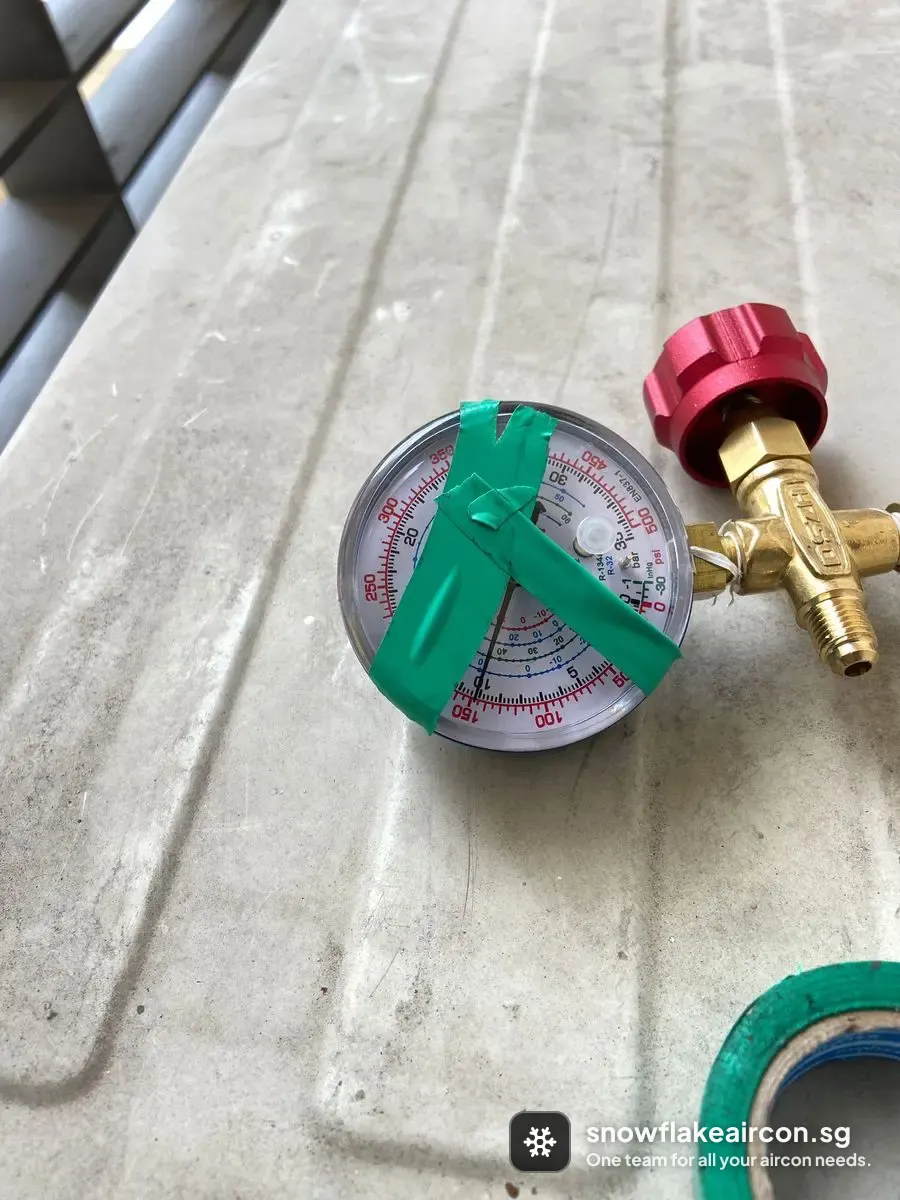
- Attaching a pressure gauge to confirm low charge and soap-testing the charging valve pin with the brass cap off
What Else Produces This
Repeat gas loss on an eight-year-old HDB System 3 splits cleanly between a tired compressor and a small external escape point. Connecting a pressure gauge at the outdoor unit answers that question before quoting heavy parts.
Connecting a pressure gauge to the outdoor charging valve reveals low standing and running pressure well beneath normal R410A targets for Singapore ambient heat.
Compressor amp draw climbs smoothly with inverter speed and shows zero hard-starting or thermal overload symptoms.
Removing the brass charging cap uncovers a faint slick of refrigerant oil around the recessed Schrader pin.
Applying soap solution directly over the valve stem produces a steady bead of micro-bubbles while nearby flare nuts remain dry.
Why It Happens
Repeated hose attachments from past top-ups compressed and nicked the small rubber ring on the charging valve core. Exposed to daily tropical heat on the Woodlands HDB ledge, the aged seal stopped closing squarely against the brass seat. Because the protective cap had also been left barely hand-tight, refrigerant bled out across several humid months until shared bedroom cooling collapsed.
What Resolution Involves
Recover the remaining charge safely and remove the leaking valve core instead of topping up blindly again. Install a fresh refrigerant-rated Schrader core, confirm zero leakage under dry nitrogen pressure, and torque a clean brass seal cap with an intact O-ring. Pull a deep vacuum across the lines before weighing in the exact factory R410A charge.
How to Tell It Worked
Standing nitrogen pressure holds steady for thirty minutes with zero bubble formation at the new valve core. Once charged and running both Woodlands bedrooms simultaneously, supply air drops cleanly below 12 degrees Celsius and compressor current stays squarely within specification. A final soap check around the torqued brass cap confirms a dry, tight seal.
Before You Approve a Quote
Test the charging valve before replacing the compressor
- Cooling that returns after a gas top-up and fades again months later proves the compressor can still pump cold air.
- Tiny rubber seals inside outdoor HDB charging valves dry out in Singapore heat and weep slowly once the brass cap loosens.
- Swapping a worn valve core and re-sealing the cap costs a fraction of changing an outdoor compressor.