On this page
Quick summary
High-pitch night whining vibrating through Singapore bedroom walls stems either from inverter pulse modulation running near full speed or failing outdoor motor bearings. Distinguishing load-driven electronic hum from constant mechanical grinding protects sleep quality and avoids unnecessary condenser replacements.
On-site fault check: $30 ($80 VRV), waived if you proceed with repair · See diagnosis & repair
Separate Inverter Load Hum from Bearing Failure
Modern inverters regulate compressor speed using high-frequency pulse-width modulation (PWM), producing a faint electronic whine whenever cooling demand approaches maximum load. Once bedrooms cool down, normal inverter pitch drops noticeably lower.
By contrast, dry outdoor fan bearings or worn compressor internals produce harsh metallic squeals that persist regardless of room setpoint. Hardened mounting pads also transmit high-frequency hum straight through concrete walls.
Compare Night Whine Symptoms from Inside the Bedroom
Listen indoors for thirty minutes after raising the thermostat slightly to sort normal modulation from wear:
Scroll to see more columns
| Night acoustic clue | Response to milder setpoint | Likely root cause | Safe next step |
|---|---|---|---|
| Pure high electronic tone | Pitch softens once room cools | High-load pulse modulation hum | Set 25°C and enable quiet mode |
| Stuck full-speed whine | Never drops even after midnight | Dust-choked coil or low gas | Rinse indoor mesh; book coil check |
| Dry screech or grinding | Stays raspy at any fan speed | Failing outdoor motor bearings | Switch off zone; book S$30 check |
| Sharp wall-borne drone | Shakes wall beside piping | Brittle rubber condenser feet | Record clip; check mount isolation |
Keep Safety Boundaries Clear While Checking Airflow
Perform acoustic checks entirely inside your flat without leaning out bedroom windows or stepping onto exterior HDB aircon ledges. Never open 230V outdoor terminal covers or touch hot discharge tubing.
Raise bedroom temperature to 25°C and turn off unused zones briefly to test whether compressor pitch drops. Record a clean phone clip near the wall before requesting an assessment.
Decide When to Book Fault Testing or Acoustic Inspection
Targeted diagnosis separates dirty coil overwork from failing outdoor motors before noise escalates:
- Diagnostic fault checks run S$30 for residential systems and S$80 for VRV plant; repair approvals waive the inspection charge and include 30 days workmanship cover.
- Clogged heat exchangers push compressors to noisy limits; general upkeep relieves load at S$50 single, S$30/head on dual splits, and S$25/head across triple-plus flats (14-day warranty).
- Stubborn coil fouling requires chemical rinsing at S$80 single, S$70/head on dual splits, and S$60/head across triple-plus flats (60-day warranty).
- Heavily blocked barrels amplify turbulence noise and clear via stripped overhauls at S$150 single, S$125/head on dual splits, and S$115/head across triple-plus flats (90-day warranty).
Diagnostic Cases for This Fault
Singapore jobs showing what we checked on-site before quoting parts or gas.
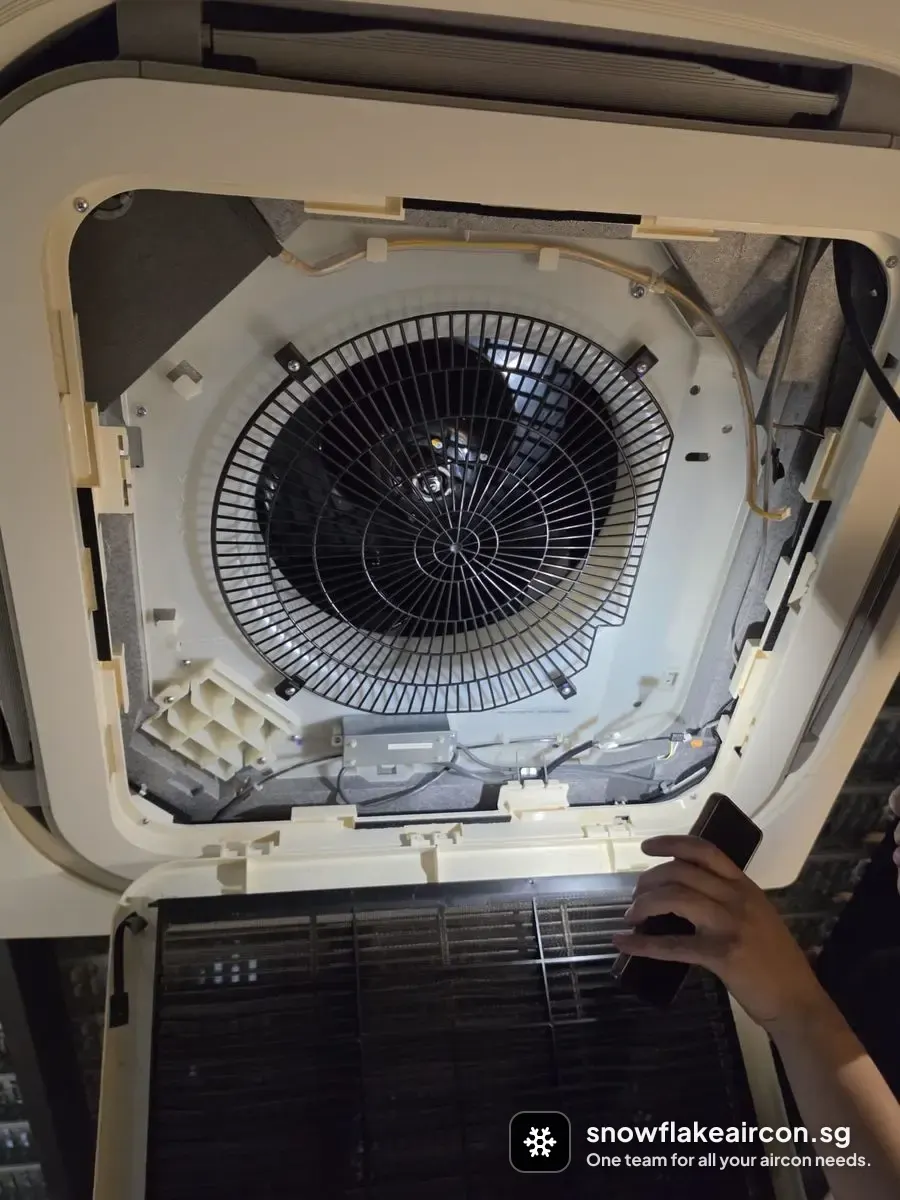
Mitsubishi Electric · Cassette
Cassette rattling at mid speed: off-centre fan blade clip
A fan blade sitting fractionally off-centre, grazing the housing across one speed band
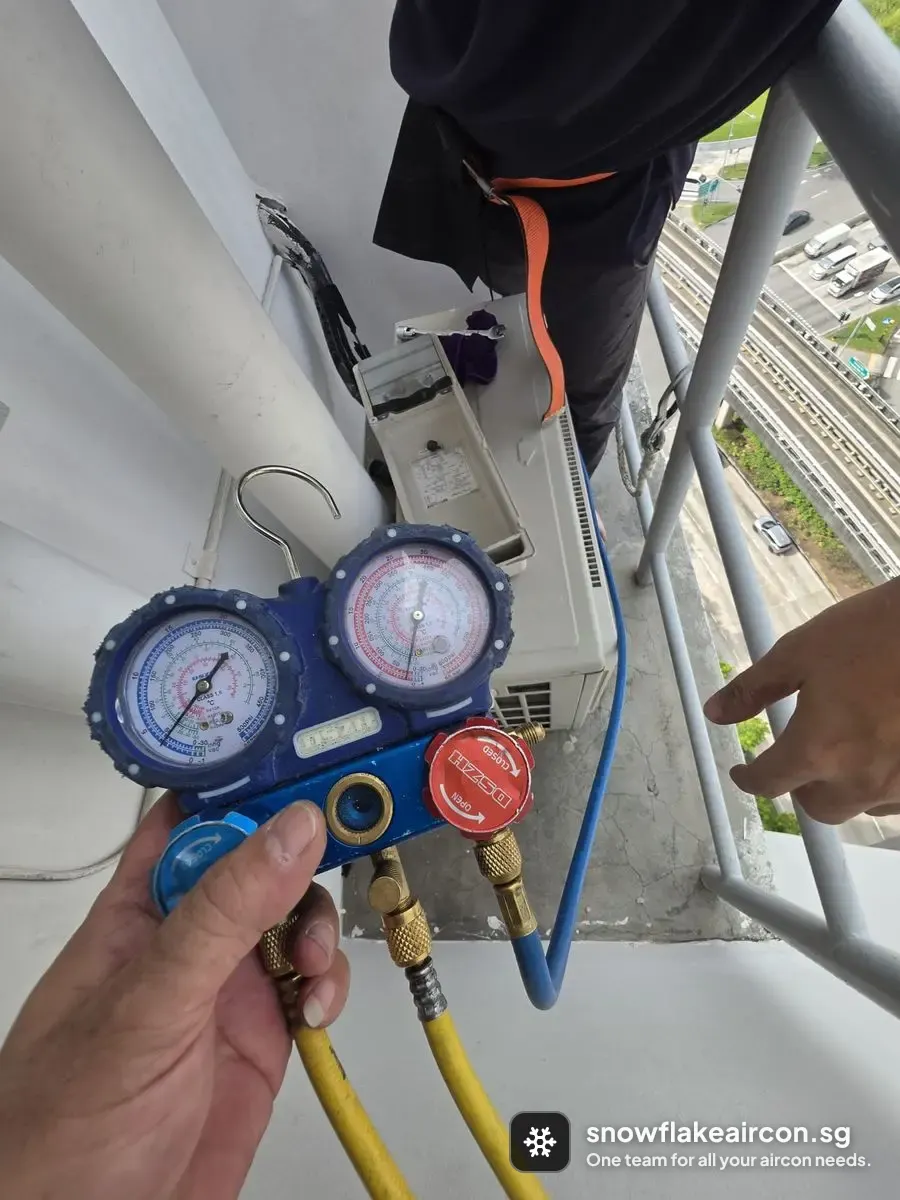
Panasonic · Multi-split
Stacked condensers vibrating wall: perished rubber mounts
Flattened anti-vibration rubber mounts and copper pipework vibrating against the upper steel bracket
Common Questions
Why does an inverter aircon compressor whine louder after midnight in Singapore?
How can residents test if high-pitch night noise comes from overload or a bad bearing?
Does lowering room setpoint to 18 degrees make compressor whine worse?
Can cleaning indoor and outdoor coils stop a compressor from whining at 100% load?
Sources
Sources checked 27 Nov 2026