On this page
Quick summary
Where water leaves a Singapore wall aircon points straight to the cause. Centre vent drips signal sweating louvres or iced coils; side corner drips point to unit tilt, cracked trays, or bare flare joints; back-wall streaks indicate choked rear troughs. Published fixes run from S$25 general care to S$150 overhaul or S$30 diagnosis.
Diagnostic Map by Exact Drip Location and Flat Cost Tier
Homeowners often assume every leaking split unit has a clogged drain pipe. In humid Singapore bedrooms, water can condense outside the tray altogether, spill over a tilted corner, or seep down behind the mounting plate where vacuuming alone never reaches.
Match the wet zone on your wall unit against this quick fault and published cost map:
Scroll to see more columns
| Exact drip location | Most likely mechanical cause | Quick home clue to check | Typical Snowflake rate tier |
|---|---|---|---|
| Bottom centre louvre or air vent | Sweating diffuser, dirty coil, or low airflow icing | Water beads on cold flap or blows out as mist | S$50/S$30/S$25 general or S$80/S$70/S$60 chemical |
| Left or right bottom corner | Tilted mounting plate, cracked drain pan, or bare flare nut | Steady drop at one end right where trunking leaves | S$30 fault check (waived on repair) or pipe re-wrap |
| Running straight down back wall | Blocked recessed rear tray or unsealed wall hole | Paint bubbles or wet streak below the chassis | S$150/S$125/S$115 full overhaul (90-day cover) |
| Dripping along PVC trunking run | Degraded 3/8-inch foam or sagged drain slope | Trunking feels ice-cold and damp outside bedroom | S$30 fault visit (offset on pipe or foam repair) |
Why Water Drips from the Bottom Centre Air Vent
Drops along the centre flap form when humid air hits ice-cold fins or a slow blower drum. Cracking a window open while running 18°C pulls damp night air onto the cold plastic vent, making it sweat.
A dust-caked mesh filter or mouldy blower wheel also restricts wind across the middle of the coil. Cold air lingers inside the housing, chills the plastic blades below dew point, or builds frost that melts into a sudden splash after shut-off. Cleaning filters and booking general servicing (S$25 to S$50) or chemical servicing (S$60 to S$80) fixes mild centre condensation.
Corner Leaks Versus Back-Wall Streaks Behind the Chassis
Steady dripping from either lower corner often traces to gravity or exposed copper. If the wall plate settles out of level away from the drain outlet, condensate pools at the lower end and spills past the lip. On the piping side, a torn insulation cuff over the brass flare nut lets cold metal sweat directly out the corner gap.
Water trickling flat down your painted wall behind the fan coil is a classic rear-tray overflow. Wall units carry a narrow secondary channel behind the evaporator block. Once algae jelly plugs that rear channel, water runs straight down the backplate. A full chemical overhaul (S$150 for one unit, S$125 for two, S$115 for three-plus) strips the unit to flush both trays and carries a 90-day warranty.
Safe Steps to Take Before Booking Your Leak Repair
Running a leaking fan coil overnight risks water reaching the indoor PCB sensor bay or swelling parquet flooring beneath the wall.
Follow these steps before scheduling your technician:
- Switch off the aircon and kill the wall isolator if droplets run near a power socket or extension strip.
- Lift the cover and rinse both mesh screens under tap water. Shine a torch on the blower blades to check for black fuzz.
- Snap one clear phone photo showing whether water exits the centre vent, side corner, or painted back wall.
- Book general or chemical care for mild front drips, or an overhaul for back-wall leaks. For tilt, cracked pans, or wet joints, start with a S$30 fault visit (offset on repair, 30 days cover).
Diagnostic Cases for This Fault
Singapore jobs showing what we checked on-site before quoting parts or gas.
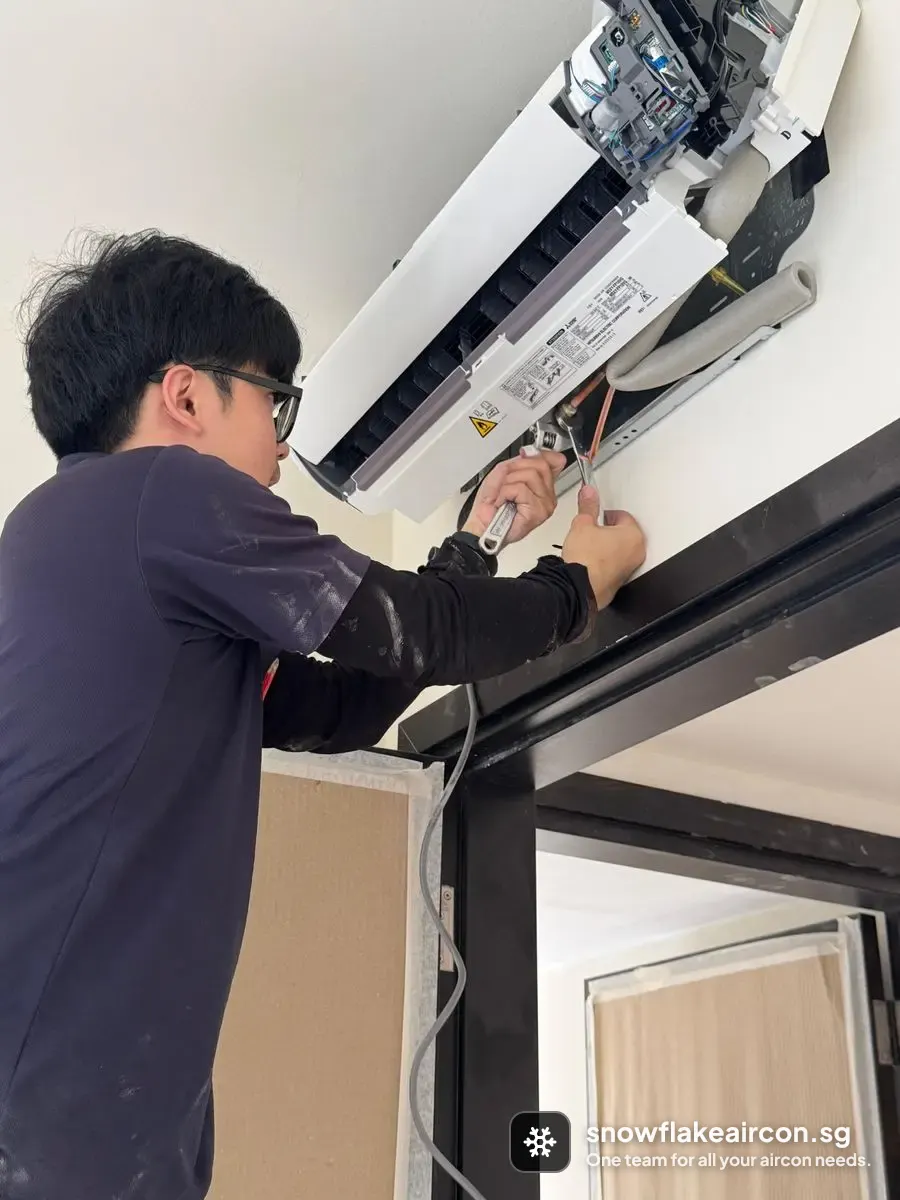
Serangoon Condo · Daikin
Serangoon Condo Corner Drip: Bare Pipe Joint, Not Tray
Compressed, moisture-soaked foam insulation around the copper flare and drain connections behind the lower chassis sweating past the edge of the drain tray
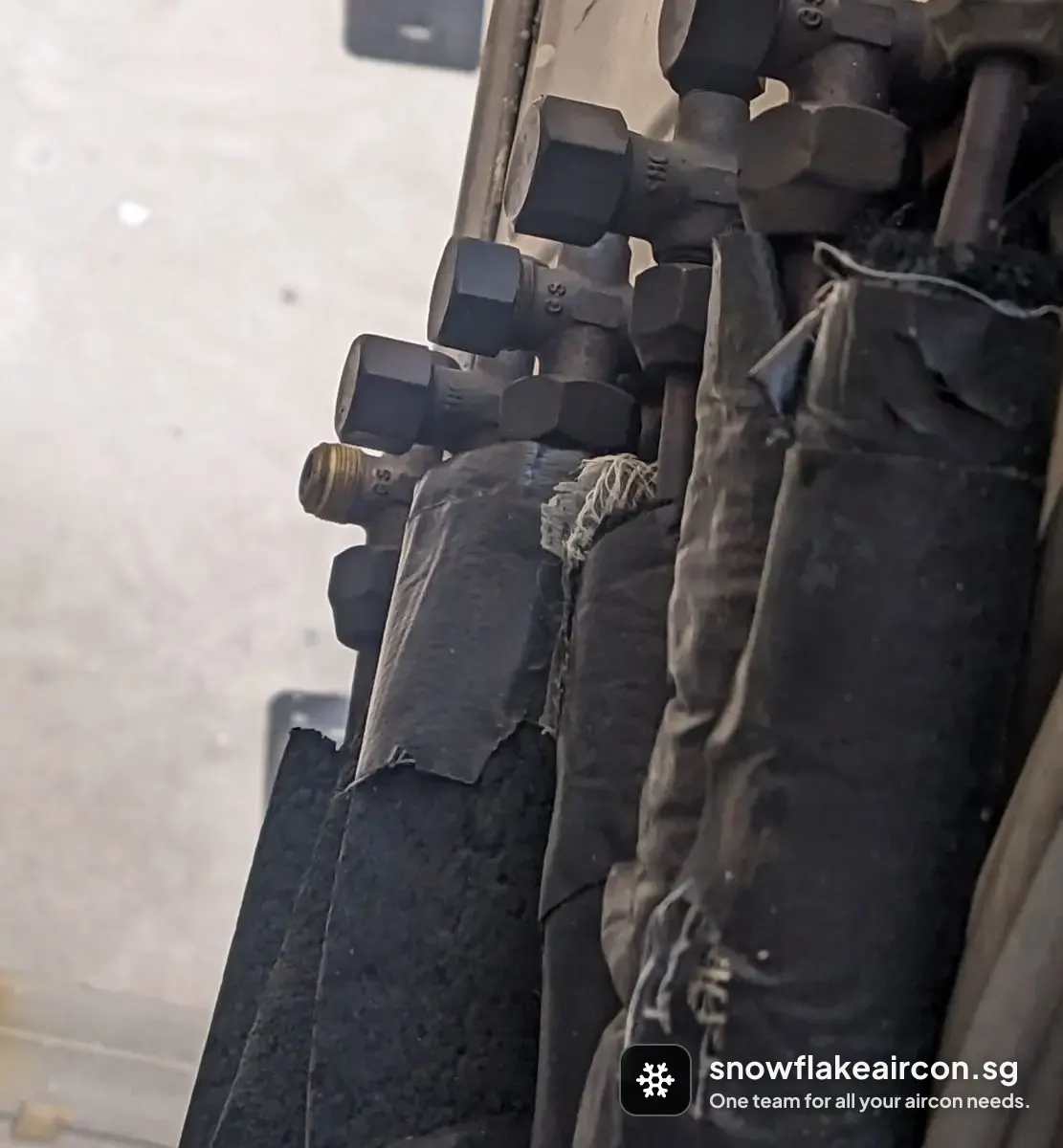
Clementi HDB · Mitsubishi Heavy Industries
Ledge Pipes Dripping Downstairs: Torn Lagging, Not Gas
Perished and torn outdoor closed-cell pipe lagging exposing chilled copper lines to humid air