On this page
Quick summary
Capsule dorm aircons in Singapore backpacker hostels operate up to 24 hours daily while catching continuous bedding lint, guest moisture, and constant remote tampering. Tamper-locked 24-degree wall controls, alternating multi-split FCU rotations, and scheduled monthly plus quarterly servicing keep bunk pods dry without shutdowns.
Wall-mounted general servicing $25–$50/unit · chemical wash $60–$80/unit · View servicing rates
Understand Why Capsule Dorm Aircons Foul Twice as Fast
Unlike residential bedrooms cooled eight hours nightly, shared capsule dorms often stay occupied round the clock as travellers check in across flight schedules. Continuous runtime triples condensate water volume and pushes fan bearings harder.
Constant sheet changes shake fine cotton lint directly into high-mounted fan coil intakes. Guests also leave spare remotes on 16 degrees under low fan, icing over choked fins within weeks.
Pair Guest Thermostat Locks with Staggered Blower Servicing
Combine simple physical controls with rotating clean windows between morning check-out and afternoon check-in:
Scroll to see more columns
| Dorm pain point | Visible hostel impact | Control or setup fix | Recommended cadence |
|---|---|---|---|
| Guests setting 16 degrees | Iced coils and wasted kWh | Wall controller lock at 23-24 degrees | Check lock weekly at reception |
| Bedding lint on mesh | Warm upper bunks and noisy fan | Staff filter rinse during turnovers | Every 7 to 10 days |
| Continuous drain slime | Drips onto top capsule pods | Slope PVC pipes plus enzyme flush | Monthly routine; quarterly chemical |
| Zero downtime needed | Cannot close occupied dorm | Stagger paired FCU clean rotations | Service during 11am-2pm gap |
Lock Controller Limits and Review Commercial Energy Spend
Wired hotel-grade wall panels with temperature range limits prevent travellers from driving compressors nonstop at 16 degrees. Keeping dorm rooms near 23 to 24 degrees with small pod circulation fans maintains dry comfort while cutting compressor strain.
Under Singapore's 31.16 cents/kWh residential tariff reference, running a choked 2 kW dorm circuit continuously wastes hundreds monthly before commercial tariff surcharges. SME operators planning equipment upgrades can verify eligible Energy Efficiency Grant criteria on GoBusiness.
Schedule Rotating Dorm Cleans and Lock Controller Limits
Rotate maintenance head by head between 11am and 2pm so paying guests always keep cool dorm zones:
- Book monthly general checks across high-turnover bunks: single FCUs cost S$50, twin FCUs cost S$60 total, while three or more average S$25 apiece carrying 14-day workmanship terms.
- Schedule quarterly chemical washes when cotton grease clings inside wheels: S$80 covers one FCU, S$140 covers two FCUs, and S$60 per head covers three or more FCUs (60-day cover).
- Clear stubborn shophouse drain jelly via thorough teardown overhauls: one head bills S$150, pairs run S$125 per unit, and three-plus units run S$115 per set (90-day warranty).
- Inspect erratic VRV shophouse controllers for S$80 (standard split fault assessments bill S$30 and drop off repair bills carrying 30-day cover).
Diagnostic Cases for This Fault
Singapore jobs showing what we checked on-site before quoting parts or gas.
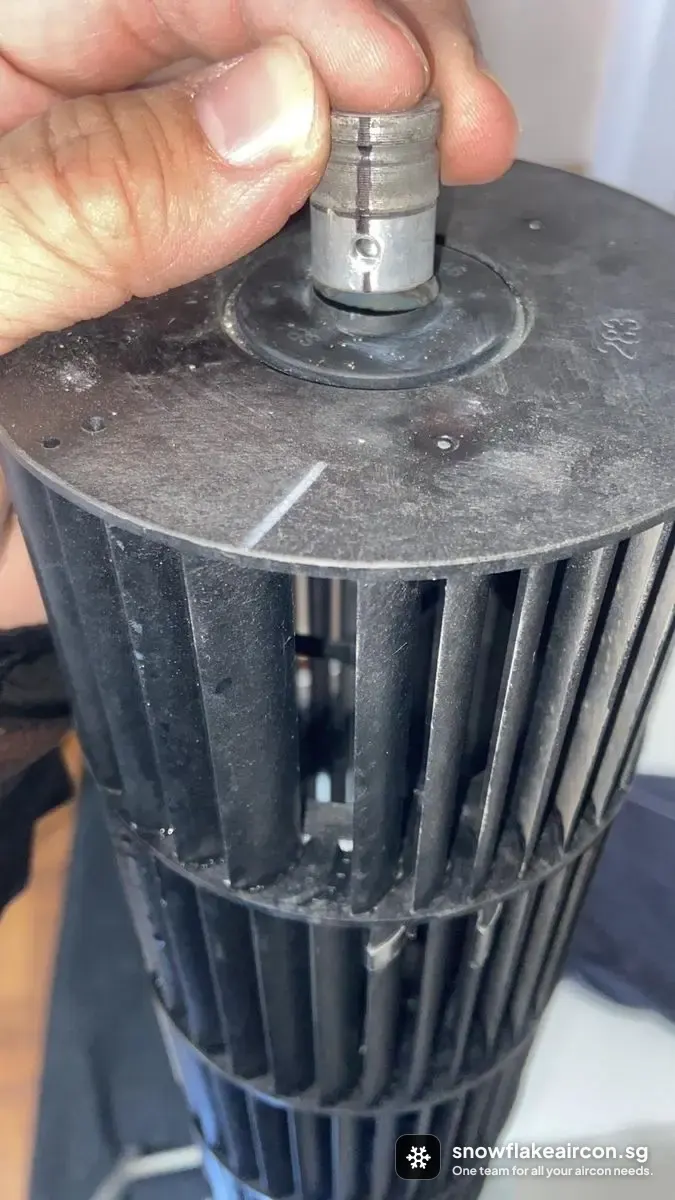
Midea · Wall-mounted
Rattling on startup: blower wheel loose on the shaft
A blower barrel drifted along its shaft after the setscrew backed off
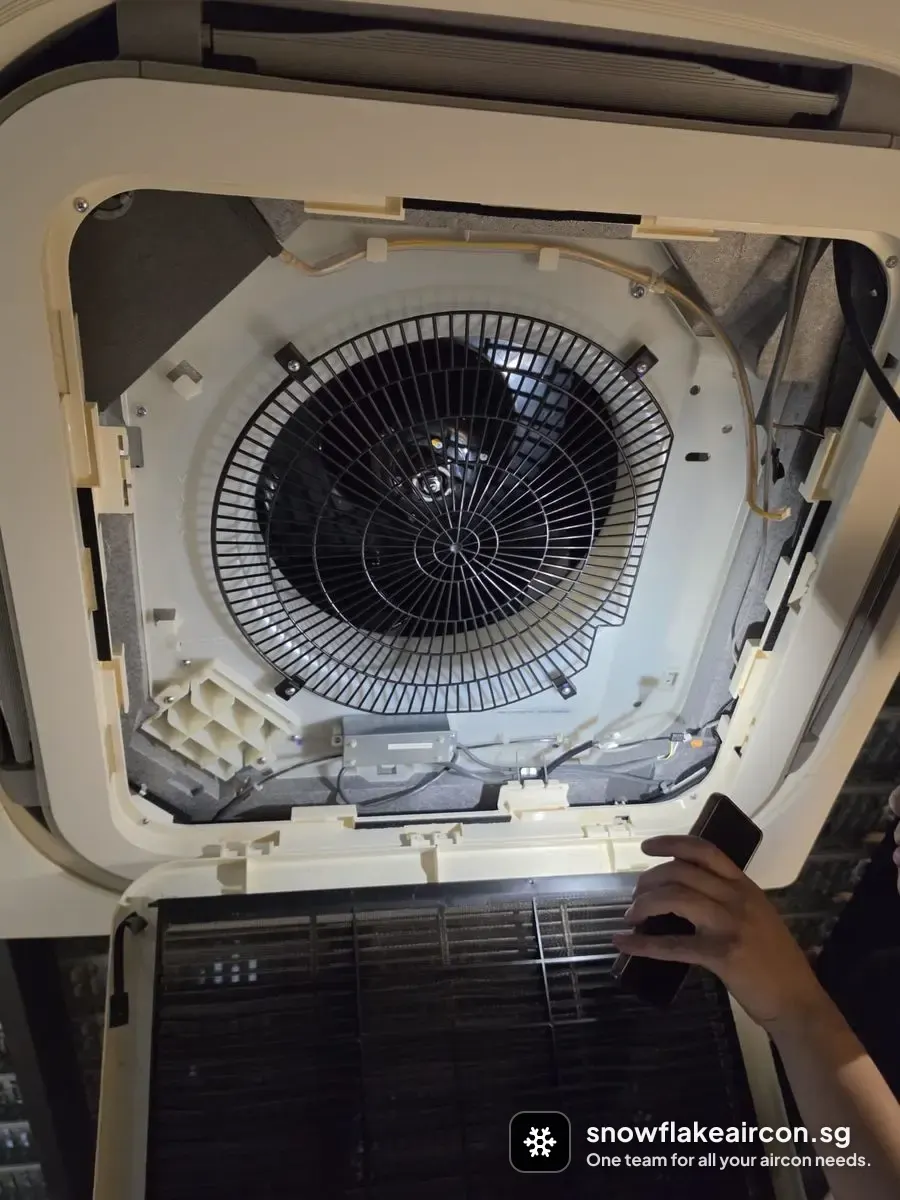
Mitsubishi Electric · Cassette
Cassette rattling at mid speed: off-centre fan blade clip
A fan blade sitting fractionally off-centre, grazing the housing across one speed band