On this page
Quick summary
Pharmacies and retail dispensaries in Singapore protect medicine stability between 15 and 25 degrees by pairing redundant split aircon circuits with disciplined moisture control. Staggered servicing schedules prevent drain overflows, coil icing, and sudden midday shutdowns while keeping shelves dry.
Wall-mounted general servicing $25–$50/unit · chemical wash $60–$80/unit · View servicing rates
Manage Retail Dispensary Heat and Outdoor Moisture Infiltration
Every automatic sliding-door cycle at a neighbourhood pharmacy pulls sticky outdoor air toward prescription and traditional Chinese medicine shelves. Oversized compressors cool the shop too rapidly. They switch off before extracting latent moisture from paper cartons.
Well-matched inverter splits run steady low-speed cycles instead. Continuous moderate airflow holds shelves between 15 and 25 degrees while keeping packaging crisp.
Isolate back-room stock storage onto its own dedicated split where space allows. Placing digital thermohygrometers near ceiling diffusers and lower racks also flags doorway humidity spikes early.
Compare Single-System vs Redundant Retail Cooling Arrangements
Evaluate common heartland shop and mall dispensary configurations before signing annual maintenance contracts:
Scroll to see more columns
| Cooling setup | Temperature and moisture stability | Outage resilience | Upkeep approach |
|---|---|---|---|
| Single multi-split condenser | Steady if door air curtains seal well | Full outage if one PCB faults | After-hours chemical wash only |
| Two independent split systems | Balanced latent removal on alternate runs | 50% cooling holds during faults | Stagger service across live shifts |
| Dedicated storage unit plus front split | Tight 15 to 25 degree lock in stock room | Dispensary stays cold during front work | Bi-monthly front wash; quarterly back wash |
| Mall central VRV / chilled branch | Consistent airflow during mall hours | Dependent on MCST chiller runtime | S$80 VRV fault checks; after-hours overnight |
Prevent Bio-Slime Drainage Backups During Long Daily Hours
Twelve-hour retail duty grows thick algae inside drain trays much faster than residential bedrooms. Once jelly-like slime plugs the outlet elbow, condensate overflows onto display stock. Emergency shutdowns follow fast.
Iced evaporator coils also choke airflow across medicine shelves when dust cakes return filters. Staff should inspect dry floor-level intake screens weekly. Leave wet blower dismantling and drain flushing to trained technicians.
Monitor SP Group electricity statements and check GoBusiness Energy Efficiency Grant criteria before replacing old retail condensers. Keep exterior brackets and drain pipes compliant with BCA inspection rules so neighbouring walkways stay dry.
Schedule Staggered Dispensary Servicing Without Stopping Sales
Plan alternating circuit servicing every six to eight weeks so stocked medicine aisles remain protected:
- Shut down one independent split circuit while the partner condenser protects the 15 to 25 degree shelf band.
- Routine general servicing runs S$50 for a single FCU or S$30 per FCU for paired blowers. Multi-head retail shops with three-plus FCUs pay S$25 per FCU under a 14-day guarantee.
- Chemical washes strip heavy street dust and tray algae at S$80 on one unit or S$70 each on two. Shops running three or more units pay S$60 each with a 60-day warranty.
- Dismantled chemical overhauls bill S$150 (1 unit), S$125 apiece (2 units), or S$115 apiece (3+ units) carrying 90-day cover. Diagnostic checks cost S$30 on splits (S$80 on VRV) and waive when repair proceeds under a 30-day warranty.
Diagnostic Cases for This Fault
Singapore jobs showing what we checked on-site before quoting parts or gas.
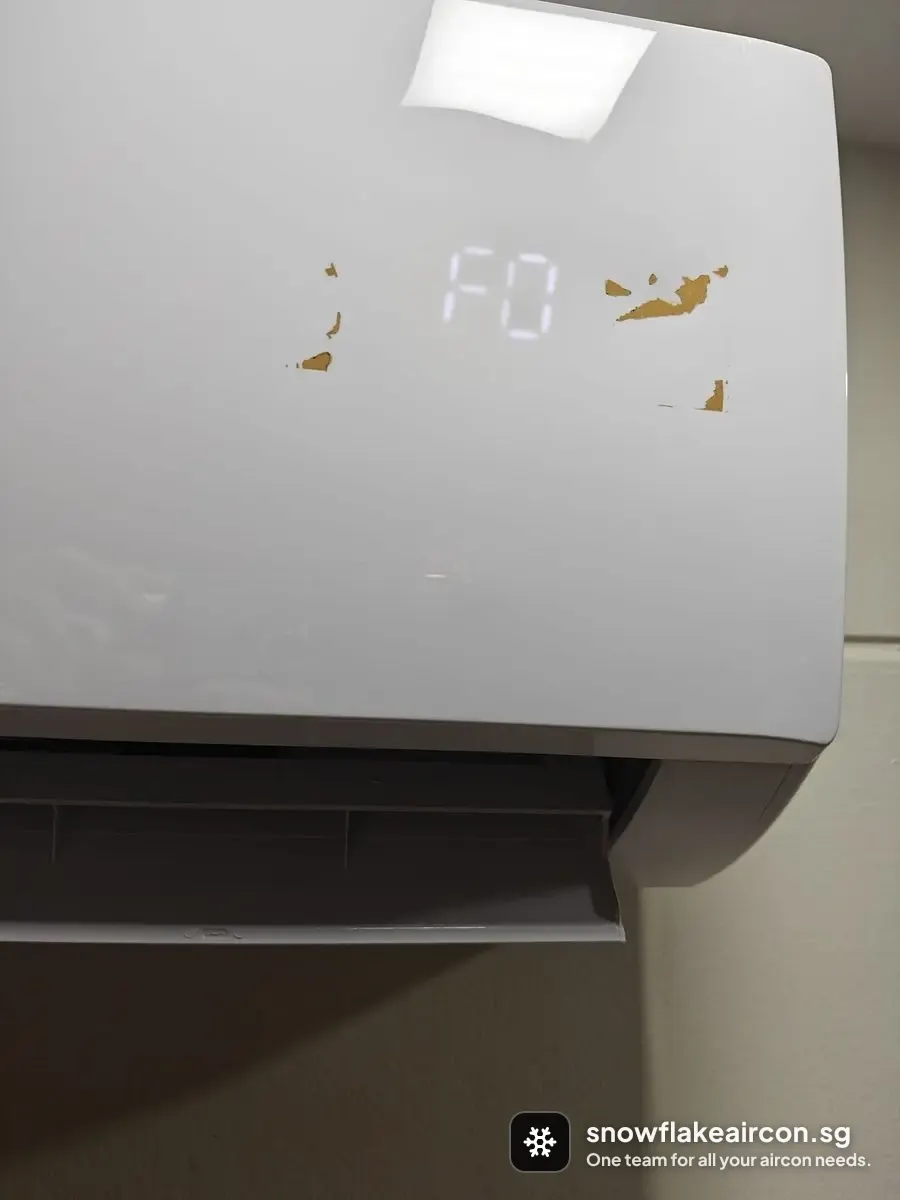
Gree · Wall-mounted
Gree F0 on a rusted condenser: refrigerant shortage
R32 refrigerant shortage triggering Gree F0 protection from corroded evaporator return bends
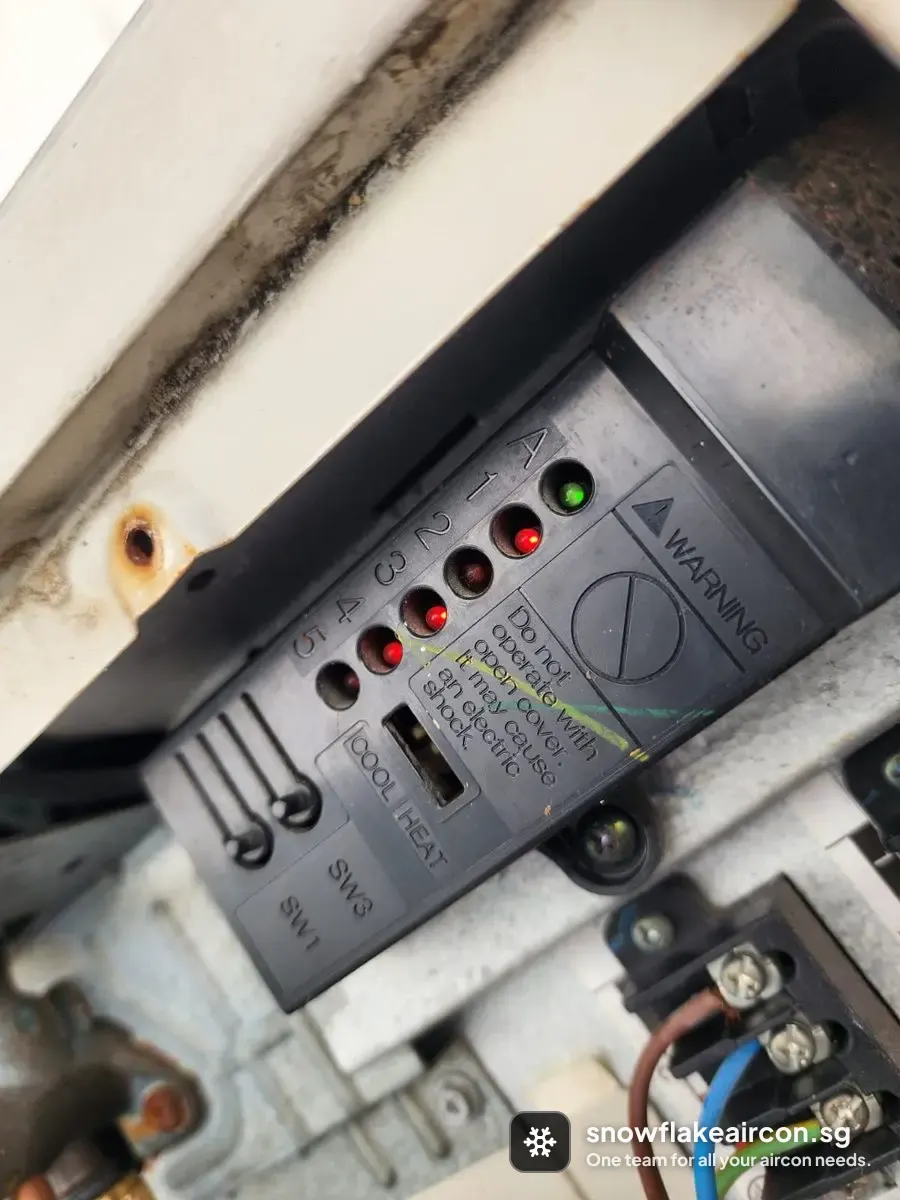
Daikin · Wall-mounted
Daikin J6 outdoor red LED: bad thermistor, not condenser
Open-circuit Daikin outdoor heat-exchanger thermistor halting multi-split cooling via outdoor safety protection while the inverter compressor stays healthy