On this page
Quick summary
Yellow greasy halos near Singapore wall trunking usually expose weeping compressor oil leaking from a cracked copper flare union rather than plain water condensation. Blotting stains safely from floor level tells homeowners whether a drain wash or S$30 leak test is needed.
On-site fault check: $30 ($80 VRV), waived if you proceed with repair · See diagnosis & repair
Why Weeping Flare Joints Leave Sticky Yellow Rings
Compressor oil circulates inside sealed copper pipes alongside R32, R410A, or R22 gas. When an indoor flare nut cracks beside wall trunking bends, pressurised refrigerant carries misted oil outward.
Plain condensate water evaporates cleanly off walls, whereas compressor oil stays tacky. Bedroom dust clings to that greasy halo, turning white PVC trunking edges yellow-amber or dark grey.
Keep Indoor Trunking Checks Safe at Floor Level
Switch off the wall aircon isolator before touching marks beside trunking. MOM ledge safety notices and EMA electrical rules forbid climbing onto ledges, leaning outside windows, or opening 230V electrical covers.
Stand firmly on indoor flooring and press dry kitchen paper lightly against outer paint stains. Leave PVC trunking covers sealed. Never twist brass flare nuts using household wrenches.
Compare Pass or Fail Stain Checks Safely
Check these four indoor clues after powering off to separate harmless moisture from oily flare leaks:
Scroll to see more columns
| Indoor clue | Pass water sign | Fail oil-leak warning | Recommended step |
|---|---|---|---|
| Dry tissue blot | Wets tissue, dries clean | Leaves greasy amber tint | Switch off; book S$30 check |
| Stain surface feel | Chalky dry wall streak | Tacky, dust-grabbing halo | Keep clean photo for tech |
| Cooling performance | Cold air, sweating pipe | Weak chill plus greasy elbow | Request nitrogen leak test |
| Access safety line | Floor level, power off | Near 230V box or window ledge | Stop; call trained crew |
Decide Between Drain Cleaning, Re-Flaring, or Replacement
Match your floor-level tissue test to the right fix across Snowflake's flat rate tiers:
- Oily residue requires dry nitrogen leak testing and clean re-flaring via a S$30 inspection (waived on repair or replacement; S$80 VRV), holding 30-day repair coverage.
- Dry drain streaks clear through basic washes costing S$50 once, S$30 per blower when pairing two, or S$25 per blower on three-plus setups with 14-day warranty.
- Biofilm-clogged trays clear via chemical servicing costing S$80 once, S$70 per blower when pairing two, or S$60 per blower on three-plus setups with 60-day warranty.
- Blocked coils needing full stripping bill S$150 once, S$125 per blower when pairing two, or S$115 per blower on three-plus setups (90-day warranty), while worn flats may tap S$400 5-tick HDB vouchers up to end-2027.
Diagnostic Cases for This Fault
Singapore jobs showing what we checked on-site before quoting parts or gas.
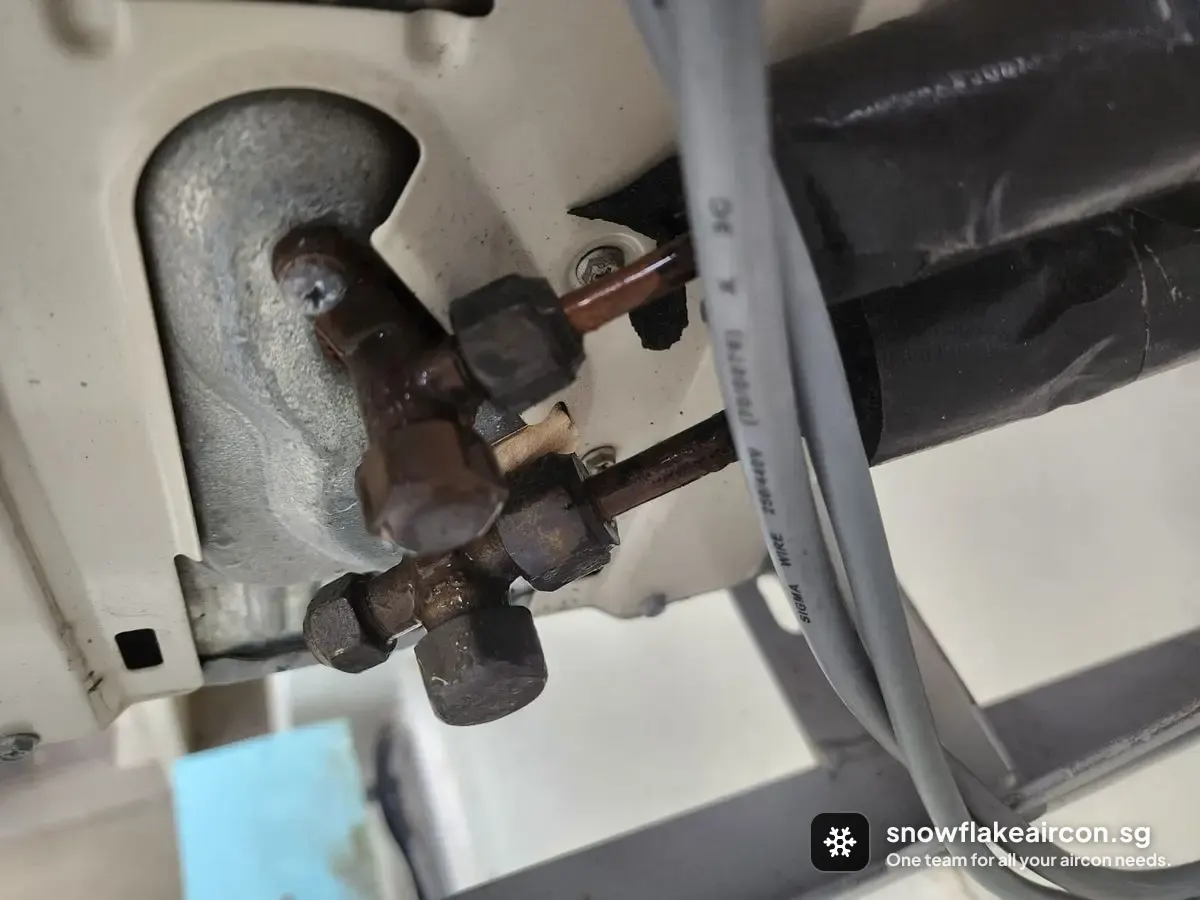
Samsung · Wall-mounted
Coastal unit losing gas again: salt ate the pipe fitting
A corroded outdoor fitting thinned past the point where it can seal
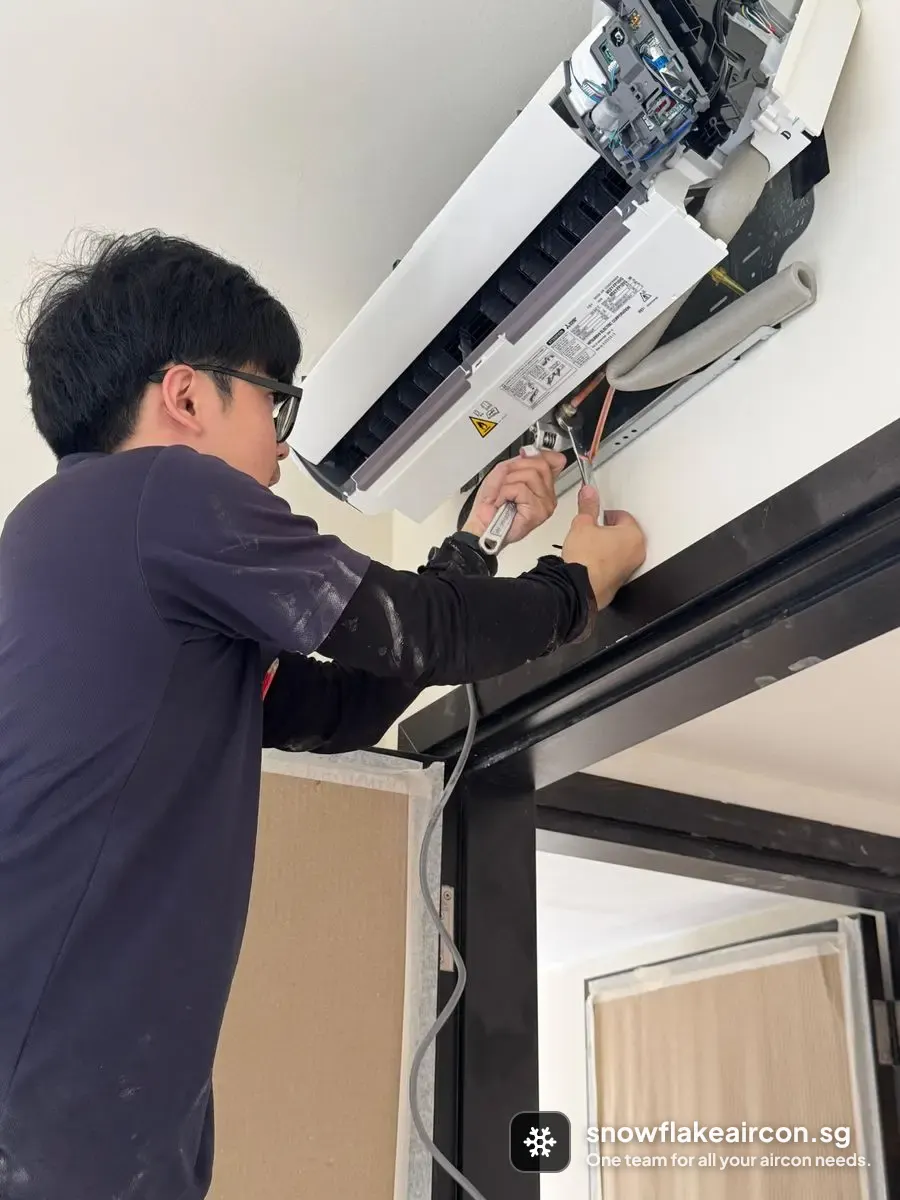
Daikin · Wall-mounted
Corner drip under unit: compressed pipe insulation, not tray
Compressed, moisture-soaked foam insulation around the copper flare and drain connections behind the lower chassis sweating past the edge of the drain tray
Common Questions
How does a compressor oil stain near trunking differ from an ordinary water leak?
Is weeping oil from an aircon pipe joint dangerous inside a bedroom?
Can homeowners pry open trunking and tighten weeping flare nuts themselves?
Why do technicians pressure-test with nitrogen instead of just adding refrigerant gas?
Sources
Sources checked 27 Nov 2026