On this page
Quick summary
Rattling wall blowers or uneven bedroom airflow often stem from sticky lint packed along curved indoor fan teeth. Shutting off the wall isolator completely and shining a phone torch upward from floor level exposes dust buildup safely before booking servicing.
Wall-mounted general servicing $25–$50/unit · chemical wash $60–$80/unit · View servicing rates
Spot How Dust Clumps Unbalance Indoor Blower Teeth
Behind every horizontal swing flap sits a cylindrical fan wheel with narrow curved plastic blades. Humid bedroom air binds skin flakes, pet hair, and fabric lint into heavy ridges between those curved teeth. Units beside curtains or indoor laundry racks accumulate lint notably faster.
Uneven dust ridges throw the spinning shaft off balance. Rooms soon hear dull thumping sounds, pulsing drafts, or fine mist spitting onto walls. Never poke brushes or sticks inside fragile vanes because snapped teeth ruin balance. Fortnightly filter rinsing slows this blade buildup significantly.
Apply EMA, HDB, and MOM Power-Off Safety Boundaries
Switch off the handheld remote first, then turn off the wall isolator switch completely. Cutting isolator power prevents scheduled timers or smart apps from restarting blades unexpectedly. EMA electrical guidelines strictly forbid opening 230V terminal screws, circuit covers, or motor housings.
Keep both feet flat on bedroom tiles under HDB, BCA, and MOM safety guidance. Never climb onto chairs, beds, or external aircon ledges. Leave stubborn swing flaps closed whenever motors jam.
Complete the Pass or Fail Blower Blade Visual Check
Power off cooling while the horizontal flap rests slightly open, then verify these four floor-level checks with your phone torch:
Scroll to see more columns
| Floor check stage | Safe inspection step | Pass (blades spin clear) | Fail (book S$30 check) |
|---|---|---|---|
| Isolator switch off | Confirm red light turns dark | Power fully cut from indoor board | Switch jams warm or sparks occur |
| Upward phone torch | Shine light across open vane gap | Curved grey teeth show clean gaps | Thick lint mats block fin spaces |
| Blade balance check | Look for cracked or missing fins | All plastic ribs look straight and even | Snapped teeth or scraping marks show |
| Restart airflow test | Run cool fan mode 3 minutes | Steady smooth stream without thumps | Rattling noise or mist spits out |
Book Blower Cleaning or an On-Site Fault Diagnosis
Pair your torch observation with the right service scope before dirty wheels wear out fan bearings:
- Still-noisy or wobbling blowers warrant an S$30 check. Snowflake credits that assessment fee toward approved repairs covered by a 30-day warranty.
- Fine dust clears through regular servicing. Three-unit bookings drop down to S$25 per blower, two units pay S$30 each, and single heads cost S$50 (14-day warranty).
- Packed grey lint mats call for chemical washes. Single coils run S$80, dual coils cost S$70 each, and three-coil bookings cost S$60 per blower with a 60-day warranty.
- Mould-coated blower wheels require full teardown cleaning. One teardown runs S$150, twin teardowns run S$125 each, and three-room teardowns cost S$115 per wheel (90-day warranty).
Diagnostic Cases for This Fault
Singapore jobs showing what we checked on-site before quoting parts or gas.
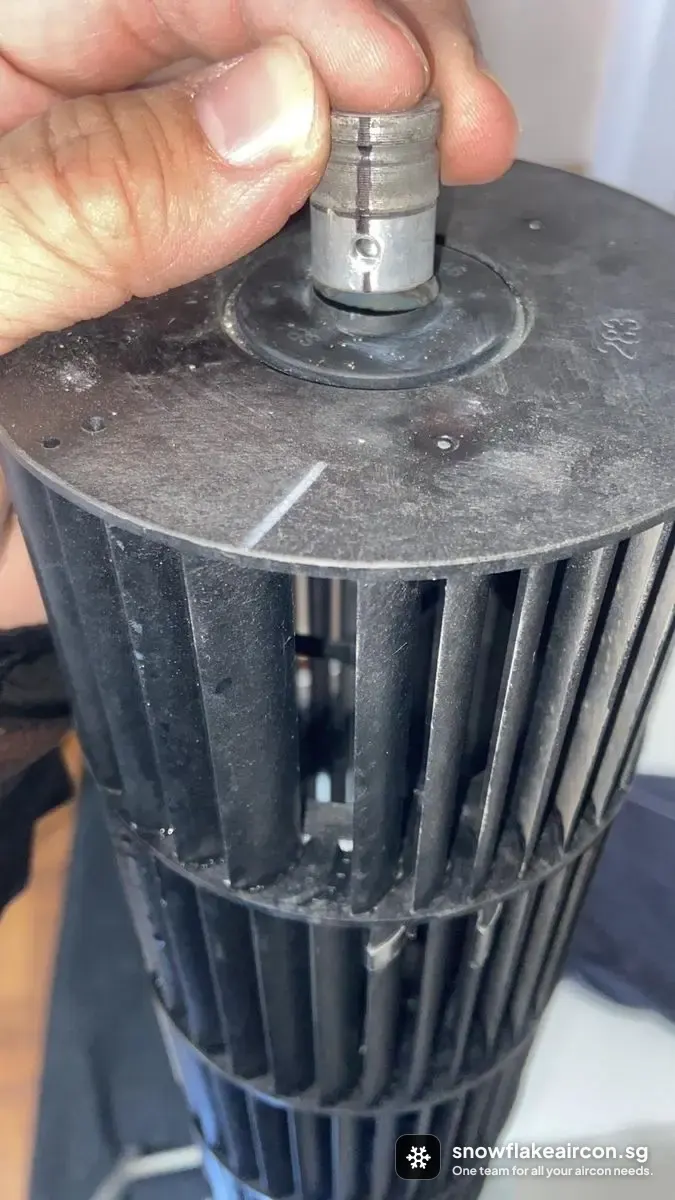
Midea · Wall-mounted
Rattling on startup: blower wheel loose on the shaft
A blower barrel drifted along its shaft after the setscrew backed off
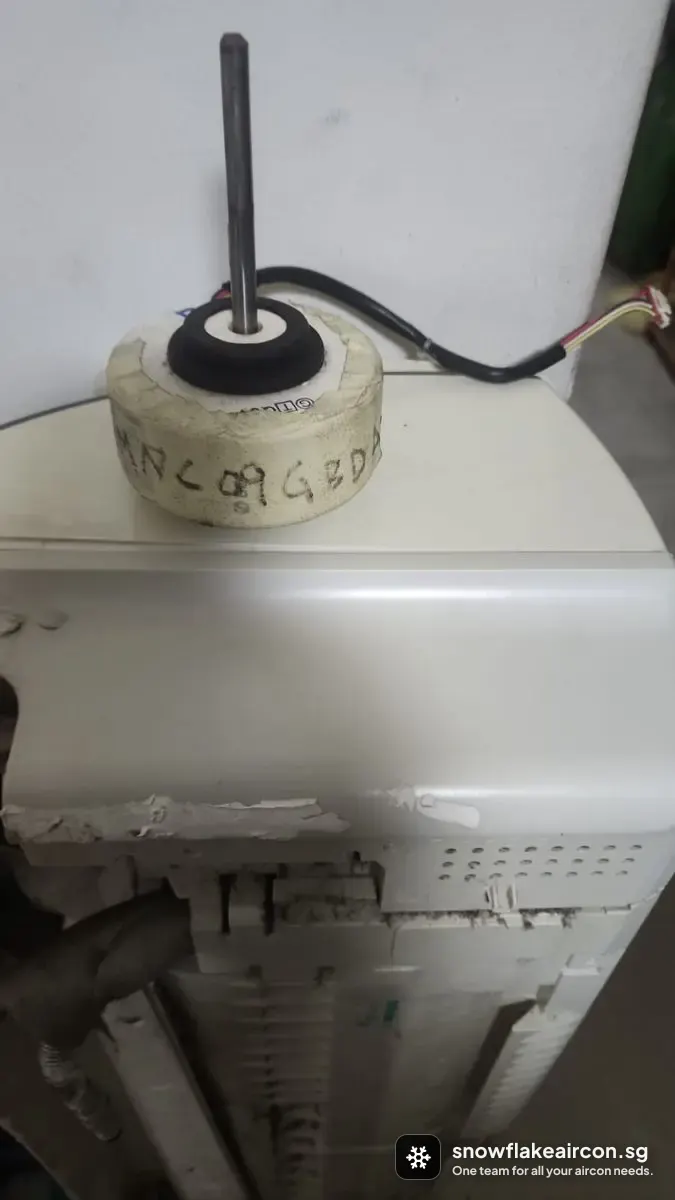
Sharp · Wall-mounted
Sharp 6-0 grinding then shutdown: worn fan motor bearings
Worn indoor fan motor bearings on a unit past its usual service life
Common Questions
Why must homeowners turn off the wall isolator before checking aircon fan blades?
Can residents poke cotton buds or chopsticks between aircon vanes to clear dust?
Why does a choked blower wheel spit fine water droplets across Singapore bedrooms?
When does a noisy indoor fan need chemical overhaul instead of general cleaning?
Sources
Sources checked 27 Nov 2026