On this page
How This Presents
A retail split serving a Museum boutique loses crisp cooling every four months despite clean indoor filters and steady airflow. Past refills briefly restore chilled shop temperatures before warm afternoon air creeps back across the display counter. Concealed pipe trunking inside finished shop plaster raises fears of messy wall work during busy retail trading hours.
- Setup
- Mitsubishi Electric Wall-mounted4-6 yearsRetailMuseum
- Misread as
- Disrupting busy daily retail trading hours to hack concealed trunking or replace an entire split system.
- Check first
- Inspecting outdoor brass joints for dark oil film and soap-testing both flare collars and the Schrader valve core under nitrogen before topping up gas
- Actual finding
- Hardened Schrader valve pin seal paired with an oily, over-compressed outdoor flare nut slowly venting R32 refrigerant behind a Museum retail shopfront
- Scope saved
- Root cause fixed once instead of repeat call-outs
What Else Produces This
Slow seasonal leaks at retail shopfronts usually live on exposed outdoor brass fittings rather than buried walls. Inspecting rear condenser connections settles leak location cleanly before disturbing finished shop interiors.
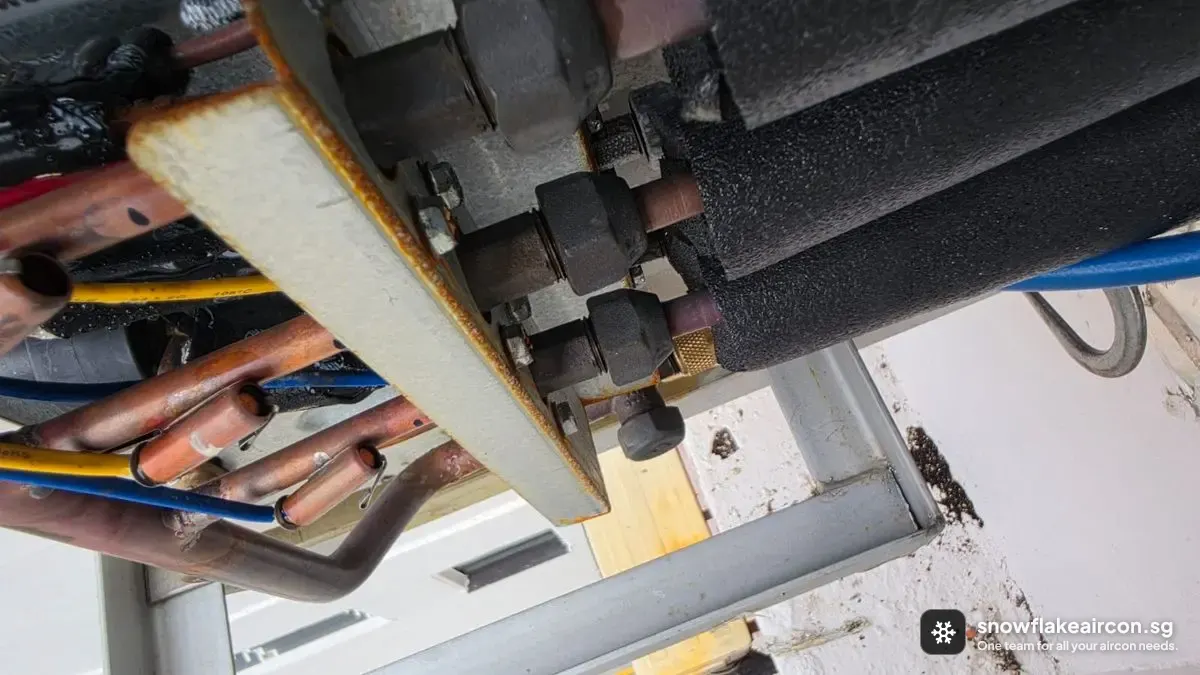
Peeling protective foam behind the Museum condenser reveals black oily grime coating the larger brass flare union.
Unscrewing the brass service cap uncovers damp oil residue along the outer cap threads and Schrader needle.
Soap leak solution forms slow growing bubbles right over the Schrader valve pin stem as well as the flare neck.
Disconnecting the oily union shows an uneven flattened copper rim scarred from past heavy wrenching.
Nitrogen pressure testing confirms concealed shop trunking and the indoor evaporator coil hold holding pressure without any drops.
Why It Happens
Repeated hose hookups and uncalibrated wrench force during earlier Museum shop top-ups fatigued the soft copper flare lip. The same heavy handling also nicked the rubber Schrader core seal. Warm alley heat gradually loosened both outdoor seals until R32 bled out every season without disturbing buried indoor pipework.
What Resolution Involves
Avoid tearing open finished retail shop walls. Recover remaining charge cleanly, swap the weeping valve pin for a fresh high-pressure Schrader core, and trim back scarred copper. Form a smooth flare cone, torque evenly to spec, vacuum deeply, and weigh exact nameplate R32 refrigerant onto a scale.
How to Tell It Worked
Test both flare unions, the replaced Schrader core, and its snug brass cap using soapy leak solution for zero bubbles. Run the Museum Starmex at full cool under warm shop load for thirty continuous minutes. Outlet temperatures stay crisp and steady while suction lines sweat coldly across busy afternoon shop hours.
Before You Approve a Quote
Check stained outdoor valve nuts and pins before approving wall pipe work
- Dark sticky dust around outdoor brass pipe nuts is the clearest visual clue that cooling gas is escaping right outside.
- Worn internal valve pins often seep slowly past plastic or loose brass caps after routine pressure checks.
- Cutting a clean copper flare, fitting a fresh valve pin, and tightening evenly seals retail loops without disturbing interior shop walls.