On this page
Quick summary
Indoor golf simulator bays trap continuous sensible heat from ceiling projectors, simulation computers, and active players inside padded booths. Sizing capacity around equipment wattage, mounting indoor blowers clear of full driver swing arcs, and keeping turf fibres off return coils prevents thermal shutdowns.
Wall-mounted general servicing $25–$50/unit · chemical wash $60–$80/unit · View servicing rates
Calculate Projector and Hardware Heat Inside Enclosed Bays
Standard floor-area sizing fails inside golf simulator bays. High-lumen ceiling projectors, dedicated graphics PCs, and bright bay LEDs emit steady sensible heat. Acoustically padded side curtains also trap warm pockets around the ceiling mount.
Total cooling output must cover equipment wattage alongside two to four swinging golfers. Commercial venues should confirm dedicated isolator capacity with an EMA Licensed Electrical Worker before adding extra condensers. Undersized breakers trip during packed weekend bookings.
Higher ceiling soffits around three metres keep tall drivers safe during full follow-through swings. Placing equipment racks outside padded hitting zones further prevents hot spots behind impact screens.
Compare Bay Placement Zones, Risks, and Clearance Options
Choose mounting positions that shield evaporator casings from swinging drivers while keeping projector exhaust cool:
Scroll to see more columns
| Bay mounting zone | Heat or swing risk | Recommended layout fix | Servicing access benefit |
|---|---|---|---|
| Behind tee soffit | Clear of follow-through arcs; sends chilled air forward | Position split or grille behind hitting mat | Stable ladder footing off screen turf |
| Beside ceiling projector | Projector exhaust short-circuits into return grille | Offset blower horizontally from lamp outlet | Stops continuous high-ambient compressor cycling |
| Side curtain wall | Errant shots or club arcs damage louvres | Mount minimum three metres high or outside bay | Prevents cracked pans and bent fins |
| Concealed ceiling duct | Acoustic foam blocks access to drain traps | Build hinged service hatch clear of turf | Allows full blower teardown without wall cuts |
Prevent Hot Pockets Near Projectors and Electrical Trips
Never blow freezing supply air straight across a hot projector lens or exhaust grille. Rapid temperature swings stress lamp optics and trigger moisture condensation when main doors open. Aim cool airflow toward players while drawing warm ceiling air cleanly toward the return.
Commercial shophouses or mall bays replacing ageing compressors should inspect GoBusiness Energy Efficiency Grant (EEG) rules. Comparing continuous daytime run hours against SP Group electricity charges also guides smarter inverter selection. Quiet low-static blowers protect coaching microphone clarity during lesson recordings and group clinics.
Schedule Regular Bay Coil Cleaning and Site Checks
Artificial turf lint and rubber tee dust clog return filters rapidly inside enclosed booths. Rinse accessible mesh screens weekly from floor height to protect airflow:
- Book an engineering visit at S$30 for commercial splits (S$80 for VRV plant). Snowflake credits this charge fully toward repairs or new installs with a 30-day repair guarantee.
- Studios maintaining three or more bays pay S$25 per booth for general servicing. Two booths cost S$30 per booth, while one booth runs S$50 under 14-day workmanship cover.
- Sticky turf grime needs chemical washes at S$60 per booth across three-plus bays. Pairs cost S$70 per booth and single bays cost S$80 with 60-day workmanship protection.
- Heavy return-duct fouling requires dismantled chemical overhauls at S$115 per coil on three-plus booths. Dual coils cost S$125 each and solo coils cost S$150 under 90-day cover.
Diagnostic Cases for This Fault
Singapore jobs showing what we checked on-site before quoting parts or gas.
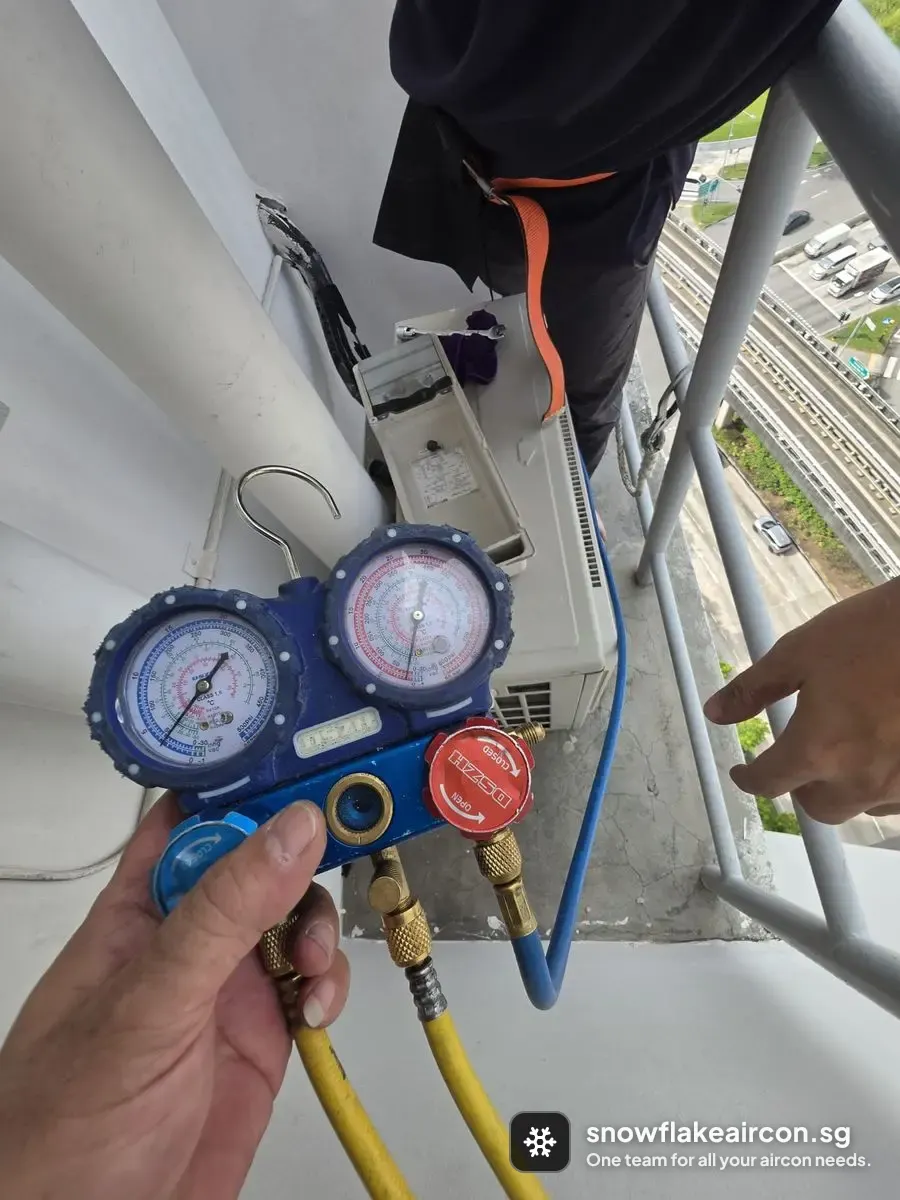
Panasonic · Multi-split
Stacked condensers vibrating wall: perished rubber mounts
Flattened anti-vibration rubber mounts and copper pipework vibrating against the upper steel bracket
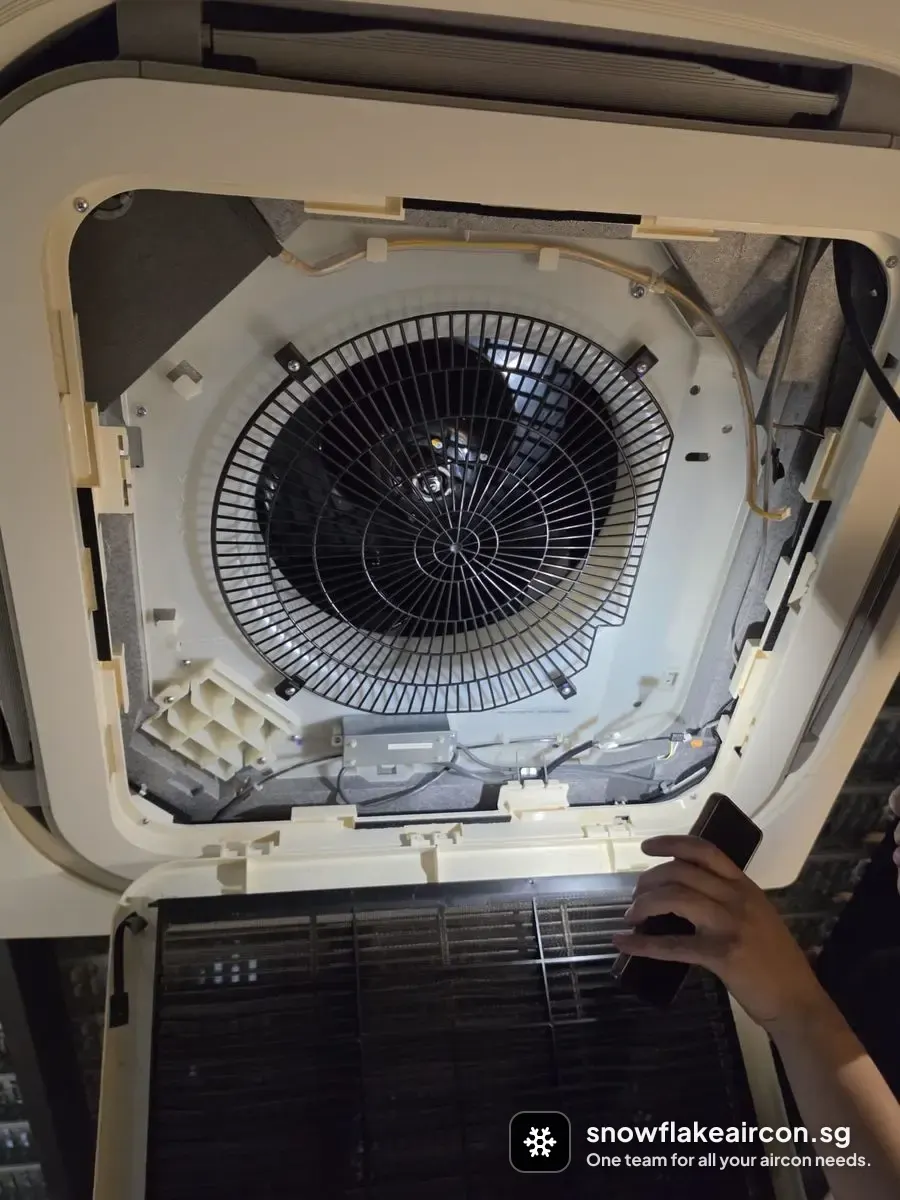
Mitsubishi Electric · Cassette
Cassette rattling at mid speed: off-centre fan blade clip
A fan blade sitting fractionally off-centre, grazing the housing across one speed band
Common Questions
Why do standard room area rules under-size an indoor golf simulator aircon?
Where should golf simulator studios mount indoor aircon units for club safety?
Can blowing cold aircon directly onto a golf projector cause damage?
How much does commercial coil servicing cost for multi-bay golf simulator studios?
Sources
Sources checked 27 Nov 2026