On this page
Quick summary
Sealed R32 and R410A aircons in Singapore never burn or use up gas during normal cooling. Treat any routine gas top-up pitch made without gauges, amp checks, and a leak test as a red flag. Ask for a measured S$30 fault check instead.
Why Sealed R32 and R410A Aircons Never Use up Refrigerant
Your residential split aircon circulates R32 or R410A inside a brazed, closed copper loop running between indoor fan coils and the outdoor compressor. Refrigerant absorbs bedroom heat and releases it outdoors without ever burning off or expiring.
When an eight-year-old HDB system stays leak-free, its original factory gas charge stays intact for the unit's full life. Genuine refrigerant loss happens only through a physical breach such as a weeping flare nut, pinholed coil U-bend, or cracked service valve.
Pumping gas into a leaking pipe without fixing the hole wastes your money. That fresh gas escapes right back out within weeks.
Genuine Low-Gas Diagnostic Proof Versus Servicing Upsell Red Flags
Unscrupulous crews sometimes claim your gas is 'half empty' after feeling the indoor vent for ten seconds, or hook up a gauge briefly while the outdoor compressor is still idling at low inverter speed. Compare real technical verification against common upsell scripts:
Scroll to see more columns
| Check step | Legitimate fault diagnosis | Fake gas upsell red flag | Question to ask on site |
|---|---|---|---|
| Pressure measurement | Gauge attached at stable full-load cool run | Verbal claim without connecting gauges | Can you show live manifold psi at full cool? |
| Normal operating range | R32 / R410A suction roughly 110 to 150 psi | Citing low R22 numbers or testing while off | Which refrigerant is on my outdoor nameplate? |
| Pipe & coil inspection | Checks for oil stains, frost on thin liquid pipe | Skips outdoor condenser and flare-nut check | Where is the physical leak point located? |
| R410A & R32 recharge rule | Leak repair, nitrogen test, vacuum, weigh-in | Quick S$60 to S$150 'top-up' without leak fix | Will you pressure-test with dry nitrogen first? |
| Written quote & cover | S$30 fault check (waived on repair), 30-day cover | Cash-only add-on with zero leak warranty | Is the leak fix and warranty written on invoice? |
How Live Inverter Gauge Numbers Can Look Low Even on a Healthy Unit
Even when a gauge is attached outside, a variable-speed inverter compressor shifts suction pressure constantly as it ramps speed up or down. Reading a manifold gauge right after startup or while a room is already cool can produce misleading swings.
Real fault checks pair gauge pressure with clamp-meter amps, air-drop readings, and oily flare-nut checks. Also, R410A is a mixed gas whose blend shifts after a partial leak. Makers specify full leak repair, vacuuming, and a weighed recharge instead of blind top-ups.
What to Say on Site to Decline Unverified Gas Top-Up Pitches
You never have to argue technical thermodynamics in your hallway to protect your wallet. Calmly ask for measured evidence before approving anything beyond your booked wash.
- Say calmly: 'Please finish my booked wash only today. I do not approve gas top-ups without a full leak check.'
- Check whether your room actually cools fine once dirty filters, blower drums, and choked outdoor coils are cleaned thoroughly.
- Still blowing warm after cleaning? Request a S$30 split check-up (waived on repair) to test flare nuts, sensors, and compressor amps.
- Before approving any gas refill, get a written quote. It must list the leak spot, repair step, vacuuming, gas type, and 30-day cover.
Diagnostic Cases for This Fault
Singapore jobs showing what we checked on-site before quoting parts or gas.
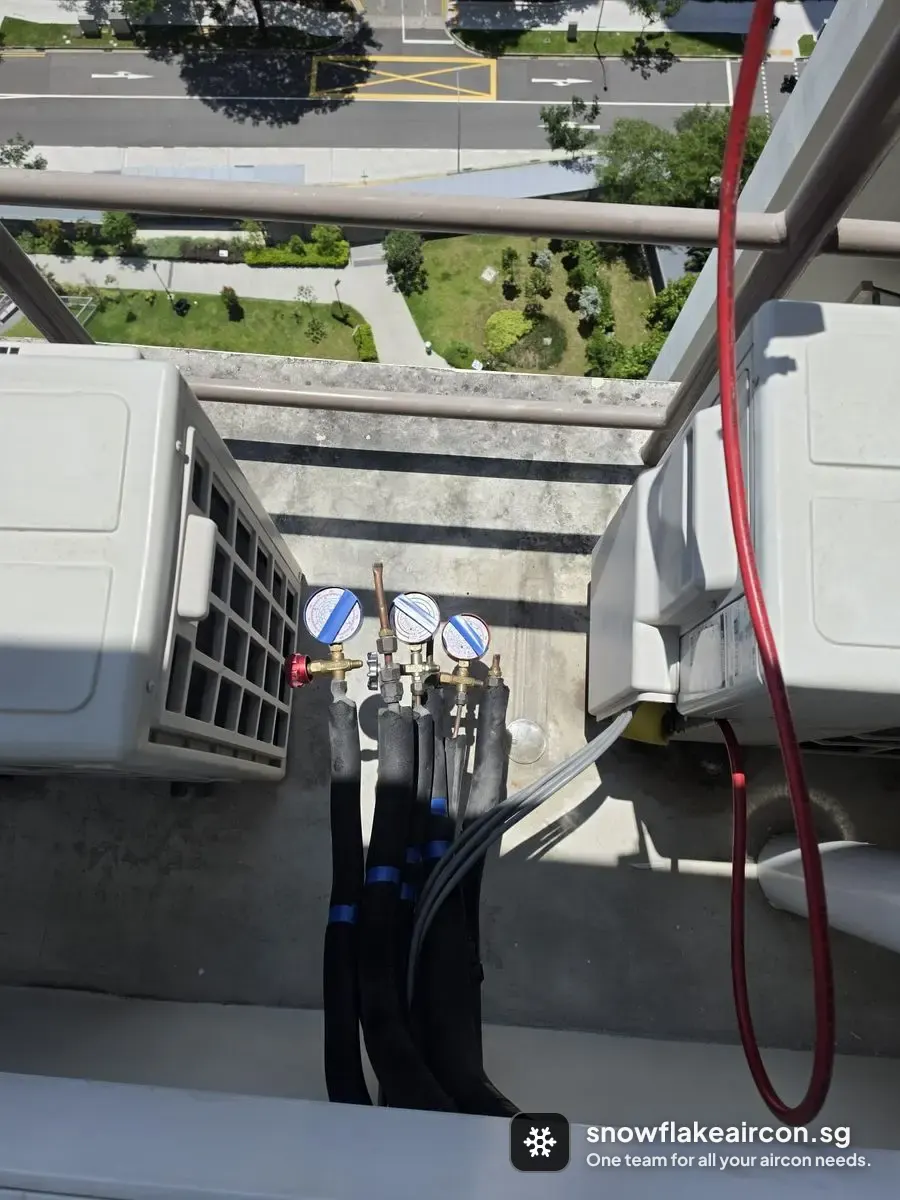
Ang Mo Kio HDB · Daikin
Manifold Check on Ledge: Slow Flare Leak, Not Compressor
Slow R410A refrigerant escape at an outdoor liquid-line flare nut
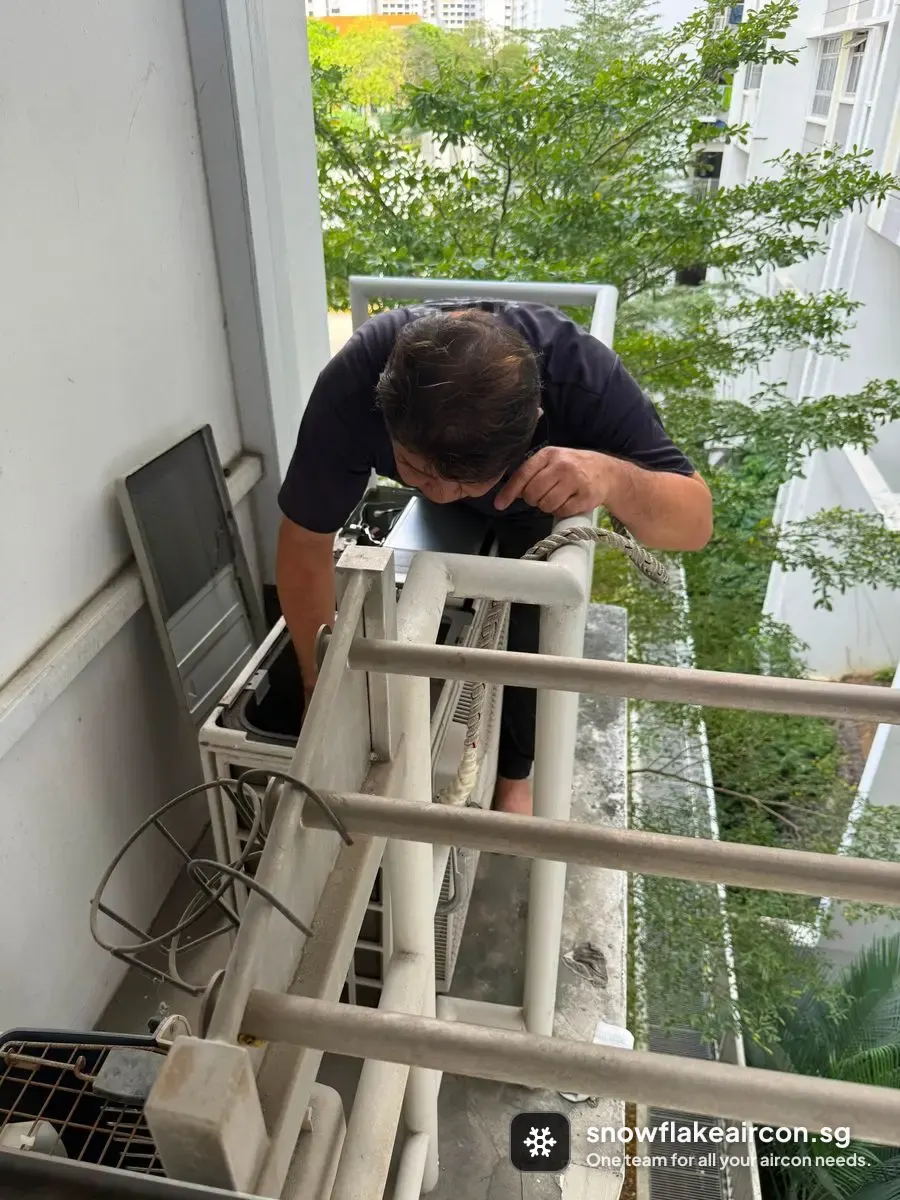
Choa Chu Kang HDB · Daikin
Choa Chu Kang Resale Flat Warm Room: 3/8-Inch Flare Leak
Slow R32 seepage at an improperly seated 3/8-inch brass flare nut on the caged outdoor condenser service valve