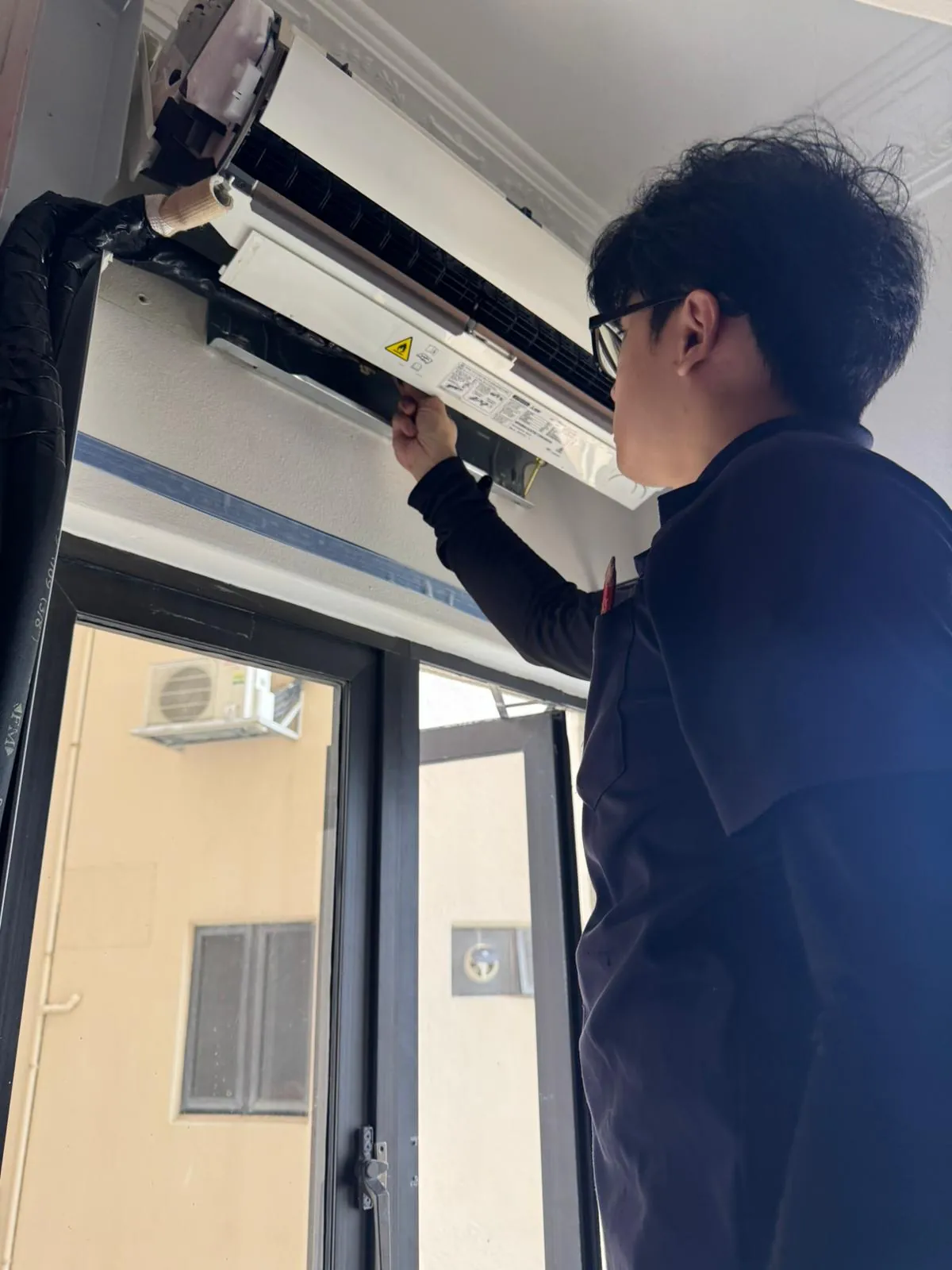
Daikin aircon thermistor repair in Singapore
A Daikin temperature-sensor code can point to the thermistor, its connector and wiring, or the PCB input that reads it. We test the thermistor, wiring and PCB input, explain what failed and quote after diagnosis.
BCA-registered10,000+ jobs completed
Signs your Daikin aircon needs a thermistor check
These symptoms can involve a temperature sensor, but they can also come from its wiring, the control board, airflow or the refrigerant circuit.
A temperature-sensor error appears
A Daikin room, coil, pipe or outdoor sensor code identifies the circuit to test, not automatically the failed part.The unit short cycles or runs continuously
An incorrect temperature signal can make the system stop too early, run longer than expected or struggle to hold the set temperature.The temperature reading or icing looks unusual
A reading that does not match the room, repeated icing or unexpected protection can justify a sensor-circuit check.
Examples of Daikin systems we check
iSmile CTKS / CTKB and MKS multi-split systems
iSmileEco CTKM / CTKP and EZi CTKC systems
iSmart ENVi FTKM single-split systems; SkyAir or VRV scope confirmed from the exact model
Model not listed
Send photos of the indoor and outdoor model labels, plus the error code or a short video of the symptom.
It may not be the thermistor
Before ordering a model-specific sensor, we check three problems that can create the same code or temperature behaviour.
Loose connector or damaged wiring
An open, shorted or corroded sensor harness can produce the same reading as a failed thermistor.PCB input fault
The sensor may measure correctly while the control board reads or processes its signal incorrectly.Airflow or refrigerant condition
A restricted coil, icing or abnormal refrigerant condition can create temperature symptoms without a failed sensor.
We match the code to the exact sensor circuit, inspect the connector and harness, measure the thermistor at the current temperature, and verify the PCB input. How a job runs, from first message to booking.
What is different on Daikin systems
Daikin codes can point to room, coil, pipe or outdoor temperature circuits. We use the exact indoor and outdoor models to locate and test the sensor named by that family.
Daikin error codes related to thermistor problems
Open the group that matches where the code appeared on your unit.
Indoor unit or controller10 guides
- A0-11An indoor-unit R32 sensor detected a refrigerant leak
- C4Faulty heat exchanger temperature sensor; Malfunction of liquid pipe thermistor for heat exchanger
- C5Malfunction of gas pipe thermistor for heat exchanger; Indoor heat-exchanger gas-pipe thermistor abnormality
- C9Faulty suction air temperature sensor; Malfunction of suction air thermistor
- CAMalfunction of discharge air thermistor; Indoor discharge-air thermistor malfunction
- CEMalfunction of switch box thermistor; Infrared presence or floor sensor error
- CHR32 refrigerant-leak sensor abnormality; R32 sensor fault, service-life warning, or replacement-input wait state (CH-01/02/05/10)
- CH-01R32 sensor malfunction in an indoor unit; R32 sensor malfunction
- CH-02An indoor-unit R32 sensor has reached end of life; R32 sensor reached the end of its service life
- CJRemote-controller thermistor abnormality; Indoor user-interface thermistor malfunction
Outdoor unit13 guides
- E4Low-pressure sensor activated
- F3Discharge temperature too high at R21T or R22T because a stop valve is closed or refrigerant is short; Compressor-casing temperature too high at R15T because a stop valve is closed or refrigerant is short
- F4Outdoor suction-temperature abnormality
- H9Faulty suction air temperature sensor; Malfunction of outdoor air thermistor
- J3Faulty discharge pipe temperature sensor; Malfunction of discharge pipe thermistor
- J5Malfunction of suction pipe thermistor; Suction-pipe thermistor R3T abnormality
- J6Faulty heat exchanger temperature sensor; Malfunction of heat exchanger thermistor
- J7Malfunction of refrigerant-circuit thermistor; Subcooling heat-exchanger liquid-pipe thermistor R5T abnormality
- J8Malfunction of refrigerant-circuit liquid-pipe thermistor; Heat-exchanger liquid-pipe thermistor R4T abnormality
- J9Malfunction of refrigerant-circuit gas-pipe thermistor; Heat-exchanger gas-pipe thermistor R6T abnormality
- JAMalfunction of high pressure sensor; High-pressure sensor abnormality
- JCMalfunction of low pressure sensor; Low-pressure sensor abnormality
- L4Inverter-fin temperature abnormality
Whole-system faults6 guides
- CH-21R32 sensor malfunction in a BS unit; R32 sensor malfunction in a SV unit
- CH-23A BS-unit R32 sensor has reached end of life; A SV-unit R32 sensor has reached end of life
- J1Malfunction of pressure sensor; Pressure-sensor malfunction
- J2Malfunction of current sensor of compressor; Current-sensor malfunction
- P4Faulty inverter circuit heatsink temperature sensor; Malfunction of radiation fin temperature sensor
- UJ-37Airflow rate below the legal limit for EKEA or EKVDX
Codes that depend on the exact model24 guides
- C0Malfunction of sensor system
- C3Malfunction of drain level sensor
- C6Malfunction of fan motor sensor or fan control driver
- C8Malfunction of AC input current sensor system
- CCFaulty humidity sensor; Malfunction of humidity sensor system
- H0Malfunction of sensor system of compressor; Sensor fault
- H1Malfunction of room temperature sensor or humidifier damper
- H2Malfunction of power supply sensor
- H5Malfunction of compressor motor overload thermistor
- H6Malfunction of position detection sensor
- H8Malfunction of compressor input current sensor
- HAMalfunction of discharge air thermistor
- HCMalfunction of hot water temperature thermistor
- HEMalfunction of drain water level sensor
- J0Miswiring of thermistor
- J4Malfunction of low pressure equivalent saturated temperature sensor
- JEMalfunction of oil pressure sensor or sub-tank thermistor
- JFMalfunction of oil level sensor or heating heat exchanger thermistor
- JHMalfunction of oil temperature thermistor
- JJMalfunction of engine room temperature sensor or exhaust temperature
- P3Malfunction of thermistor in switch box
- P5Malfunction of DC current sensor
- P6Malfunction of AC or DC output current sensor
- P7Malfunction of total input current sensor
Codes can mean different things across model and system families. Every code is in the full lookup for this brand. Last reviewed 2026-08-21.
Is Daikin thermistor repair worth it?
Parts and timing
The correct Daikin sensor is model- and location-specific. Indoor and outdoor thermistors are not assumed interchangeable; we confirm the model, sensor position, part number and distributor lead time before you approve work.Our recommendation
Thermistor repair is usually a contained job when the sensor circuit is confirmed, the correct model-specific part is available and the rest of the system is healthy. Daikin systems commonly have a service life of 10–15 years. For a system over 12 years, major component failures usually favour replacement. The unit has exceeded typical lifespan and efficiency has likely dropped. Minor fixes can buy time, but plan for replacement.
If replacement makes more sense, we compare the repair quote with a suitable new system. See our aircon system replacement process.
Other Daikin repair checks
If testing rules out this part, these are the next checks on the same system.
Workmanship warranty
We stand behind the repair we carry out, and we are straight about the part of the cover we do not set ourselves.
Labour
30-day workmanship warranty. If the same fault returns from our repair, we come back and the labour is on us, with no second diagnostic visit fee.
Parts
Parts carry the distributor's warranty for that component, so the term varies by part. We tell you both terms before you approve the work.
Frequently asked questions about Daikin thermistor repair in Singapore
What are the signs of a Daikin thermistor problem?
How do you confirm a Daikin thermistor fault?
Is a Daikin error code enough to order the thermistor?
Should I repair or replace my Daikin aircon?
We cover all of Singapore. Find aircon services in your area.
Describe your situation
Tell us what’s going on. Symptoms, setup, photos, anything we should know. We’ll assess and come back with the right next step.