On this page
Quick summary
Cooling that drops weeks after chemical cleaning usually traces back to unclipped room temperature sensors, wet thermistor plugs, or slow pipe leaks. Inspecting blower wind and probe clips avoids pointless repeat washes or blind gas refills.
Wall-mounted general servicing $25–$50/unit · chemical wash $60–$80/unit · View servicing rates
Three Faults That Stop Cooling After a Chemical Wash
Clean fins paired with warm air a month after washing point to three common faults. An unclipped air sensor resting against cold copper tricks the control board into pausing the compressor too early. Dust-free room air passes straight over clean coils yet leaves bedrooms warm.
Leftover rinse droplets trapped inside thermistor headers also shift electrical signals as pins oxidise. Meanwhile, clearing thick lint alters coil heat flow and reveals slow flare leaks that sat hidden behind grime.
Compare Sensor Slips, Damp Plugs, and Gas Leaks
Inspecting airflow and pipe frost from flat ground helps narrow down which check to order. Match your cooling symptom against these four diagnostic patterns before paying for extra cleaning:
Scroll to see more columns
| Observed cooling behaviour | Probable root trigger | Safe floor observation | Targeted technician fix |
|---|---|---|---|
| Compressor pauses after 5 minutes | Air sensor resting on cold fins | Check steady indoor blower flow | Re-clip probe in dry intake holder |
| Wild room cooling swings daily | Wet or oxidised thermistor plug | Watch for blinking timer lamp | Dry connector; test probe ohms |
| Steady warm wind plus fin frost | Coincidental flare or coil pinhole | Inspect only washable dust grid | Dry-nitrogen pressure test before gas |
| Weak rattle across fan outlet | Reassembled blower off balance | Shut isolator if scraping starts | Re-align wheel and check motor bush |
Avoid Repeat Chemical Washes or Blind Gas Refills
Booking another chemical wash within thirty days removes zero pipe leaks and ignores damp sensor headers. Refilling R32 or R410A refrigerant without dry-nitrogen pressure testing simply lets leaked gas escape again.
Leave indoor side control boxes closed in line with EMA consumer safety rules. Never unplug live 230V thermistor plugs or blast hairdryers near damp circuit boards. Trained technicians use insulated meters to verify sensor readings cleanly.
Verify the True Cause Before Paying for Extra Work
Confirm sensor readings and operating pressure cleanly before approving spare parts or fresh cleans:
- Book an on-site fault inspection at S$30, with VRV properties priced at S$80, before buying new probes or gas. Repair jobs waive the inspection fee with 30-day cover.
- Review your recent service bill first. Chemical washes carry 60-day workmanship warranties at S$80 one head, S$70 each for two, and S$60 each on three or more.
- Heavy coil sludge requires full strip-down overhauls. Snowflake bills S$150 single, S$125 per head across two, or S$115 per head for three-plus blowers (90-day cover).
- Rinse top dust grids from floor level first. Afterward, preserve repaired coils with general servicing at S$50 one unit, S$30 each on two, or S$25 per unit across three splits (14-day terms).
Diagnostic Cases for This Fault
Singapore jobs showing what we checked on-site before quoting parts or gas.
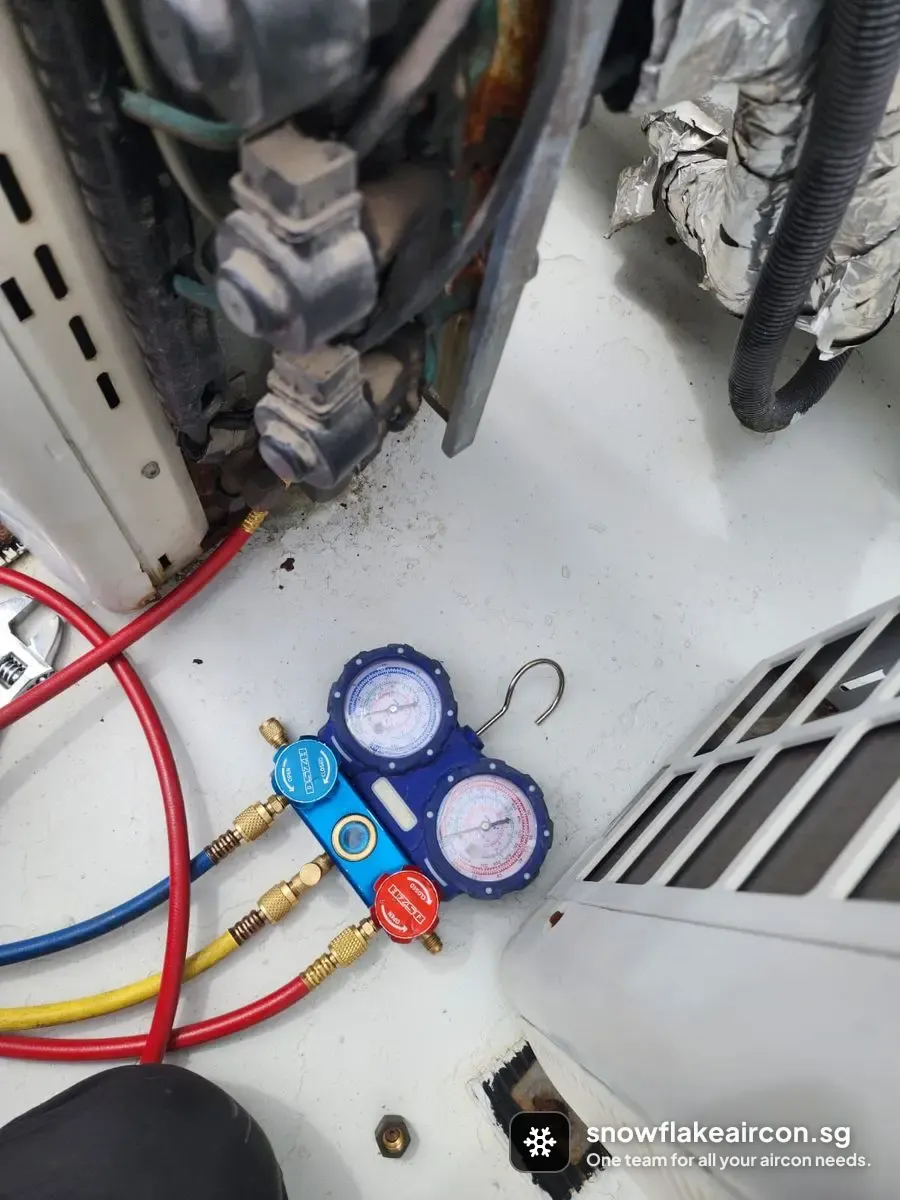
LG · Wall-mounted
LG CH35 error: gas leak at the outdoor connections
Refrigerant leak at corroded outdoor unit pipe connections
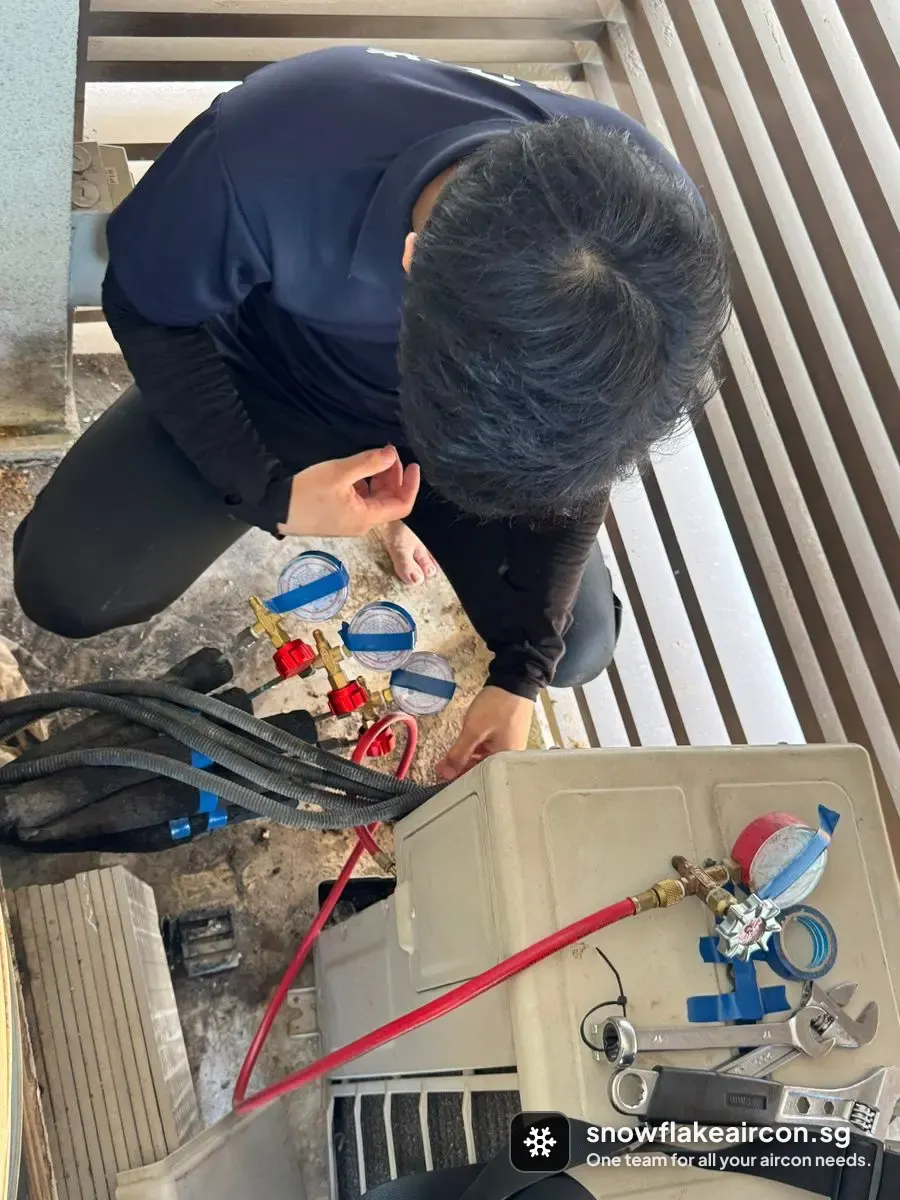
Mitsubishi Electric · Wall-mounted
Warm air with normal gas pressure: fouled coil, not low gas
Grease-choked indoor evaporator coil and dust-packed blower wheel causing poor temperature drop while refrigerant pressure stayed full
Common Questions
Why does an aircon cool well right after a chemical wash then blow warm weeks later?
Can leftover water inside an indoor thermistor plug ruin aircon cooling?
Should owners ask for a gas top-up immediately when cooling drops after servicing?
How can residents rule out filter dust safely before calling a technician back?
Sources
Sources checked 27 Nov 2026